
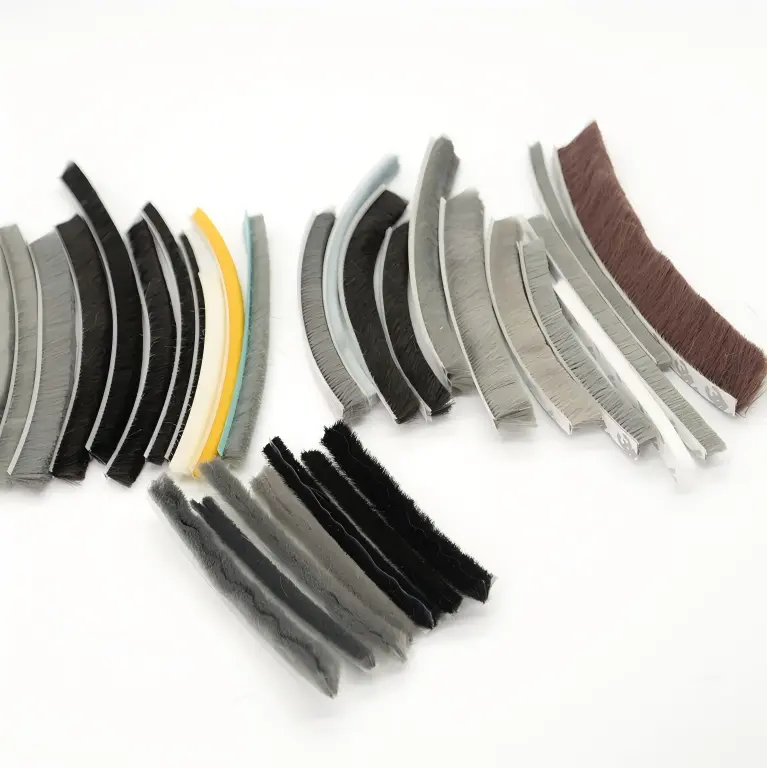
An inquiry for “.270 pile weatherstrip” is incomplete until it identifies whether .270 refers to the backing width or pile height. For OEM purchasing, keep those dimensions in separate fields and preserve the original unit. This guide translates decimal-inch dimensions without treating nearby metric sizes as guaranteed replacements.
First identify which dimension the number describes
Backing width is the width of the strip that the profile retains. Exposed pile height is measured from the pile-supporting surface to the free fiber tips. Overall height includes the backing. A catalog may use a different height convention, so ask for a cross-section before comparing two listings.
Use our general pile measurement guide for the measurement procedure. The tables below focus on conversion and purchase descriptions.
Decimal-inch backing widths converted to millimetres
Calculation: millimetres = inches × 25.4. The exact conversions below are arithmetic values, not manufacturing tolerances or a list of approved interchangeable products.
| Inch value | Exact mm value | RFQ interpretation |
|---|---|---|
| .187 | 4.7498 | Often expressed approximately as 4.75 mm; retain .187 in the drawing reference. |
| 3/16 = .1875 | 4.7625 | Close to .187, but the numbers are not identical. |
| .250 = 1/4 | 6.3500 | The exact quarter-inch conversion. |
| .270 | 6.8580 | Not 1/4 inch and not exactly 6.8 mm. |
| .310 | 7.8740 | Do not silently substitute a .312-inch backing. |
| .312 | 7.9248 | Keep this separate from .310 and from 5/16. |
| 5/16 = .3125 | 7.9375 | A fractional dimension with its own drawing tolerance. |
Why .270 inch should not become “1/4 inch”
A .270-inch backing is 0.020 inch, or 0.508 mm, wider than a .250-inch backing. That difference may affect insertion or retention. Likewise, .270 inch converts to 6.858 mm; a nominal 6.8 mm strip is 0.058 mm narrower before tolerances are considered. These calculations identify a difference. Only the drawing limits and a fit trial establish whether the difference is acceptable.
Pile-height conversions use the same formula
| Pile-height label (in) | Converted height (mm) |
|---|---|
| .190 | 4.826 |
| .230 | 5.842 |
| .270 | 6.858 |
| .300 | 7.620 |
| .350 | 8.890 |
| .450 | 11.430 |
These labels are conversion examples. They do not establish which height fits your door gap, and a .270-inch pile height does not imply a .270-inch backing width. Fin height must also be identified separately where a barrier fin is present.
Write an RFQ that a supplier can reproduce
A useful inquiry separates the drawing requirement from proposed substitutes. For example: “Backing width .270 in; exposed pile height .350 in; backing thickness and tolerances as attached drawing; fin arrangement as sample; black; required quantity ___ metres; proposed reel length ___ metres.” This is an example format, not a Gleam stock code or confirmed supply combination.
- Keep the original inch drawing and show any converted values as a secondary reference.
- Identify the receiving slot opening, internal width and depth. Include an unworn strip sample where available.
- Record the selected dimension convention and whether the fin projects beyond the fibers.
- Request a sample trial before approving a nominal metric alternative.
- State quantity, packing and destination so the technical selection can become a comparable quotation.
Choose a product by the actual application
For commercial aluminum door meeting stiles, see storefront door pile weatherstrip. Give the seal position and closing-gap measurements along with the backing size.
For a moving shutter curtain, see roller shutter guide rail brush seal. Include the rail and slat sections so pile reach and travel clearance can be reviewed together.
If the old strip has a barbed mounting leg rather than a flat backing, read T-slot versus kerf pile weatherstrip before asking for an inch-size replacement. The mounting shape can rule out a substitute even when the headline width matches.
Common purchasing questions
Does “3/16 pile” always mean .187-inch backing?
No. It may be a rounded trade description, and it may describe a height instead of a width. Ask for the dimensioned section and tolerance. Keep 3/16 = .1875 inch and .187 inch distinct in your comparison.
Can the worn pile show the original height?
Compressed or worn fibers may understate the original free height. Use the original drawing, an unworn section or a new reference sample alongside the measured working gap.
Does a converted size prove compatibility?
No. Width, thickness, retention shape, pile contact and movement all matter. A conversion table helps prepare the inquiry; it cannot replace profile and sample approval.
Industry size reference: Ultrafab’s published decimal-inch and metric backing options illustrate why decimal labels should be retained in a cross-reference.
Browse the Gleam brush seal product category when you are ready to compare supply routes.
Request an OEM quotation
Send your profile drawing or sample photos, required dimensions, quantity and delivery country. Include the installed application so we can review the fit before quoting.