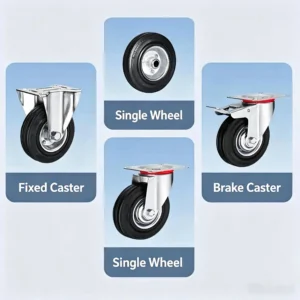
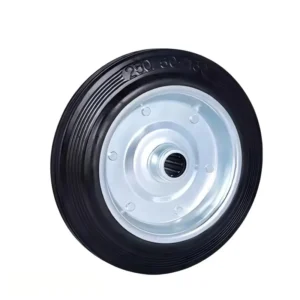
This page covers a complete industrial trolley caster wheel with a threaded-stem-style mount, not a loose replacement wheel and not a universal specification for every trolley. The photographed sample shows a black-tread swivel-caster direction with a metal bracket and stem-style connection. It does not establish an exact wheel size, stem thread, brake configuration, material grade or load rating.
For trolley manufacturers, equipment builders, spare-parts importers and distributors, the reliable buying method is to confirm the wheel, swivel assembly and mounting interface as one model. Standard catalogue configurations can be reviewed, while special mounting, material, finish or packing requirements are quoted separately.
Industrial Trolley Caster Wheels with Threaded-Stem Mounting
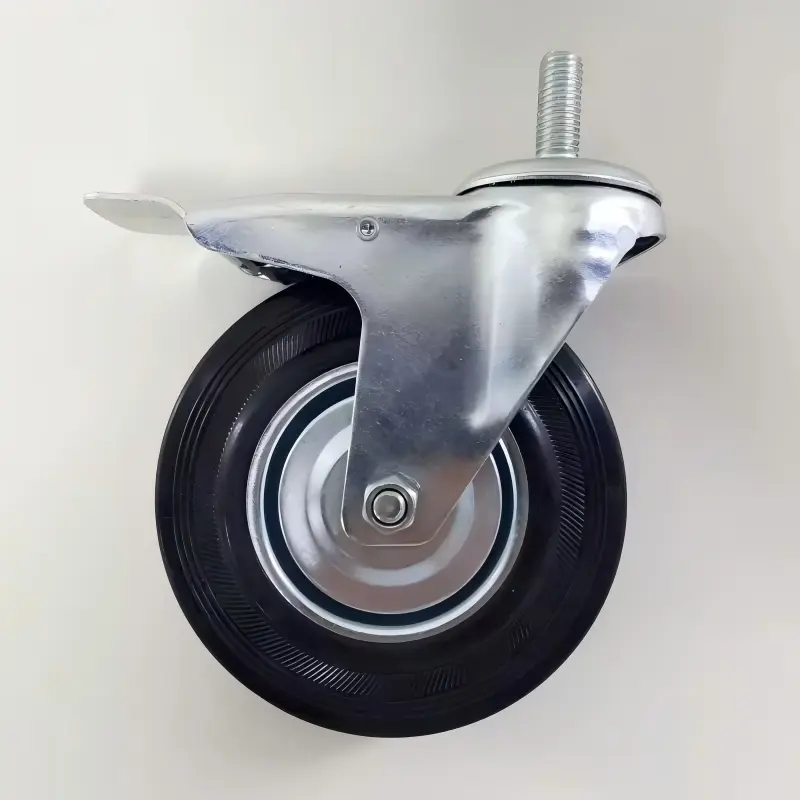
A product photograph is useful for identifying the general caster family, but visual similarity is not enough to confirm interchangeability. Stem diameter, thread form, thread length, overall height, wheel width, swivel clearance and load basis must match the customer’s equipment.
Model Selection and Confirmation Basis
| Selection item | What can be reviewed | What must be confirmed |
|---|---|---|
| Caster form | Complete swivel caster for trolley or mobile-equipment installation | Required swivel range, clearance and installation envelope |
| Mounting interface | Threaded-stem-style connection as the pictured sourcing direction | Stem diameter, thread standard, pitch, usable length and any shoulder or fastening method |
| Wheel and tread | Black-tread wheel options for indoor or defined industrial-floor conditions | Wheel diameter, width, hub or bearing construction, tread material and hardness requirement |
| Brake option | Braked or non-braked configurations can be reviewed by model | Wheel brake, swivel lock, total lock or no brake; the photograph is not proof of a locking function |
| Load basis | A suitable duty class can be proposed after application review | Total mass, caster count, load distribution, impact, speed, static dwell and the agreed safety basis |
| Operating environment | Indoor, warehouse or other defined application conditions | Floor material, debris, thresholds, temperature, moisture, chemicals and cleaning method |
| Commercial program | OEM marking, neutral or private-label packing and repeat-order controls | Quantity by model, label, barcode, pack count, carton mark and destination |
Every dimension, thread and load value is confirmed for the selected model, customer drawing or approved sample. Values from another caster that looks similar should not be transferred to this product.
How to Specify the Threaded Stem Correctly
Record the complete thread geometry
A stem description should include more than an outside measurement. Identify the thread standard, pitch, usable thread length, shoulder, nut or locking method and the space available inside the trolley frame. A drawing is preferred when the existing stem cannot be measured reliably.
Check mounting clearance and swivel movement
Confirm that the caster can rotate without contacting the frame, guard, brake pedal or nearby parts. Overall height and swivel offset affect equipment stance and manoeuvring, so the approval sample should be installed on the actual assembly.
Match the wheel to the floor and duty cycle
Tread selection depends on floor material, debris, thresholds, travel frequency, speed, impact and static periods. A generic label such as rubber wheel does not by itself establish noise, wear, rolling resistance or service life.
Application Review for Trolleys and Mobile Equipment
These industrial trolley caster wheels may be reviewed for carts, racks, mobile workstations, service equipment and material-handling assemblies when their mounting and duty requirements match the selected model. Suitability is established from the complete application rather than from wheel diameter alone.
For a new equipment program, provide the frame interface and desired equipment height. For a replacement program, send the original caster and mounting details. For distribution, list the models that must remain separate on labels and cartons so buyers can reorder the correct fit.
RFQ Information for an Accurate OEM Quote
| Information | Preferred evidence | Quotation use |
|---|---|---|
| Wheel geometry | Drawing, caliper photos or an approved reference sample | Confirms diameter, width, hub and equipment clearance |
| Stem and mounting | Thread callout, measured stem sketch and installation photo | Prevents an incompatible thread or insufficient engagement |
| Load and movement | Total supported mass, caster quantity, travel route, speed, impact and static periods | Defines the model-selection and validation basis instead of assuming one universal rating |
| Floor and environment | Floor photographs plus temperature, moisture, debris and chemical exposure | Supports tread, finish and maintenance recommendations |
| Order program | Quantity by model, annual forecast, sample plan, label and packing brief | Allows tooling, unit packing and landed-cost inputs to be compared on the same basis |
Sample Approval and Repeat-Order Control
- Application review: identify the equipment, mounting, movement, floor and commercial requirements.
- Model or drawing confirmation: record the stem, wheel, swivel and brake details that define the quotation.
- Sample installation: check mounting engagement, free swivel movement, wheel clearance and operation on the target equipment.
- Written approval: retain the accepted drawing, sample, label and packing details for repeat orders.
- Shipment checks: inspect the agreed dimensions, assembly, rotation, finish, model identification and packing against the approved standard.
Any numerical load, wear, noise or endurance acceptance requirement should be tied to an agreed test method and the exact model. Industry practice can guide selection, but it does not replace model-specific approval.
Commercial Benefits for Importers and Distributors
- Fewer wrong-fit returns: sell from a confirmed stem and equipment interface rather than a similar-looking photograph.
- Clearer product lines: separate threaded-stem complete casters from wheel-only parts and top-plate brake casters.
- Better margin control: compare quotations with the same model, packing and inspection basis instead of an incomplete headline specification.
- More stable reordering: retain an approved drawing or sample and a model-specific label for later batches.
These controls are intended to reduce avoidable specification disputes. They are process benefits, not a promise of a particular commercial result or service life.
Frequently Asked Questions
Can you quote from a photograph?
A photograph can identify the product direction, but a final quote also needs dimensions, stem details, operating conditions and quantity. A drawing or physical sample may be required before production.
Is the threaded stem a universal size?
No. Stem diameter, thread standard, pitch, usable length and fastening method are confirmed for the selected model or customer drawing.
What load capacity should I select?
Provide the total supported mass, number and arrangement of casters, load distribution, speed, impact, floor condition and safety basis. The offered rating must belong to the exact caster model and agreed test basis.
Can you provide a brake or special finish?
Available brake and finish options can be reviewed for the required model, quantity and environment. They are confirmed in the quotation and approval sample rather than assumed from this photograph.
Request an Industrial Trolley Caster Review
Send the wheel dimensions, stem drawing, mounting space, duty condition, load basis, quantity, packing and destination. We will review the applicable standard model or drawing-led OEM route before quotation.
Email: [email protected]
WeChat / WhatsApp: +86 19053267096