A grooved roller bearing must match the track as well as the axle. Many purchasing problems begin when a buyer sends only “608ZZ pulley” or a front-view photo. The bearing core may be correct while the finished diameter, groove radius, flange or hub is wrong for the rail.
This guide is for importers, door and window hardware distributors, fabricators and private-label brands specifying replacement or OEM rollers. It explains which measurements and evidence help turn a sample into a repeatable commercial SKU.
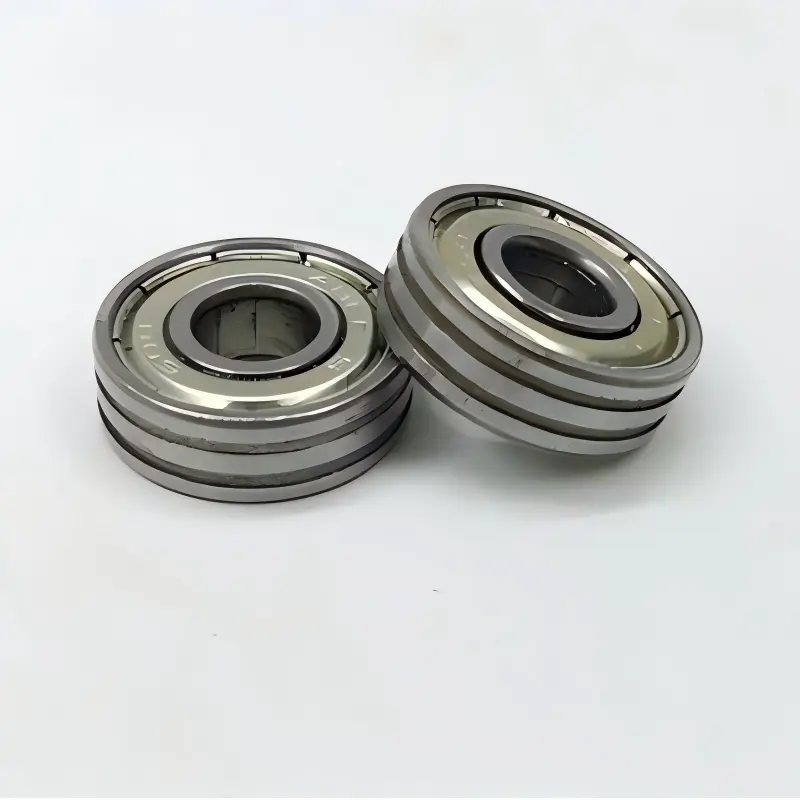
Why the Track Profile Comes First
The rolling surface guides the door or window and distributes contact against a particular rail. A flat roller, U-groove wheel, V-groove pulley, rounded concave profile and multi-groove roller are not interchangeable simply because they contain the same bearing. Track material, contact angle, alignment and installation clearance influence the final design.
Common Roller Profiles and Buyer Inputs
| Roller profile | What it controls | Information to send |
|---|---|---|
| Flat or smooth | Contact across a flat guide surface | Finished OD, width, rail width and edge clearance |
| U-groove / rounded concave | Guidance around a rounded or radiused track | Groove radius, depth, width and rail diameter/profile |
| V-groove | Contact on an angled rail | Included angle, depth, edge radii and rail section |
| Dual-groove | Two controlled contact paths | Groove pitch, depth, radius/angle and overall width |
| Multi-groove / multi-rib | Several matched rail contacts | Groove count, spacing, profile and orientation |
| Flanged or extended hub | Lateral location and bracket spacing | Flange diameter, hub length, bore and complete width |
Names vary by market. “Track roller bearing,” “door pulley bearing,” “window guide wheel” and “bearing roller pulley” may refer to related parts, but the drawing should define the final geometry.
Seven Dimensions an OEM Drawing Should Show
- Bore or shaft interface: include any sleeve and tolerance requirement.
- Finished outside diameter: measure the rolling surface, not only the bearing core.
- Total width: include flanges, shoulders and extended hubs.
- Groove width and depth: identify where measurements are taken.
- Groove radius or angle: match the rail section rather than guessing from a photo.
- Groove position and pitch: especially important for dual- and multi-groove rollers.
- Hub and flange geometry: show extensions on both sides and installation clearance.
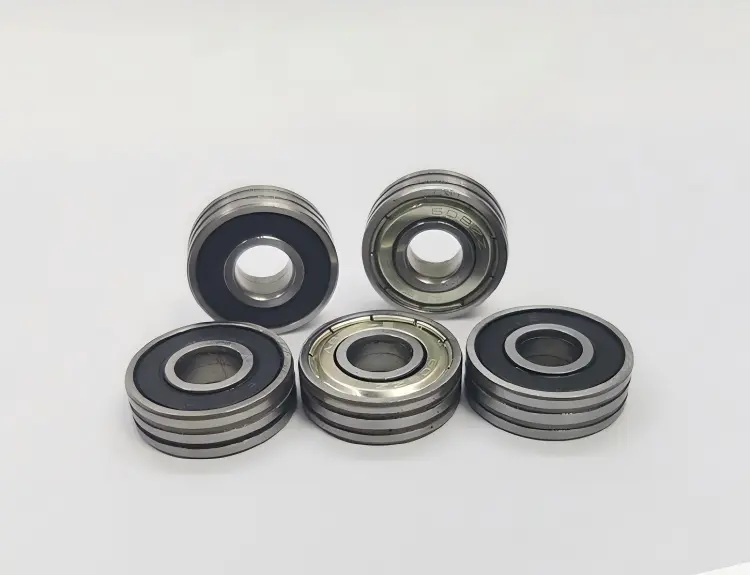
Dual-Groove, Multi-Groove and Flanged Roller Options
Our dual-groove metal track roller bearing is organized around a two-contact-path drawing. The multi-groove metal pulley bearing is intended for rails using several ribs or grooves. Where the component must locate inside a bracket, a flanged extended-hub roller bearing may be more relevant.
These are separate pages because each requires different drawing fields and sample checks. The separation is based on product geometry and procurement intent, not merely on repeating a 608ZZ keyword.
Choosing the Bearing Core and Closure
After the roller profile is understood, select the bearing core. 608ZZ, 625ZZ and 626ZZ use different boundary dimensions. ZZ and 2RS describe different closure approaches. Review our bearing model comparison, the 625ZZ shielded bearing and the 608-2RS sealed bearing before finalizing the assembly.
Metal Roller or Plastic-Coated Bearing Wheel?
| Construction | Advantages to evaluate | Specification risk |
|---|---|---|
| Formed/machined metal roller | Compact profile, defined flange/hub and matched metal track geometry | Wrong groove or hub can prevent installation |
| POM or nylon-coated wheel | Molded profile and material options for door/window systems | Bearing size alone does not define finished wheel size |
| Rubber or PU-coated bearing | Elastic contact can be evaluated for selected applications | Hardness, bond, environment and test method must be stated |
| Bare bearing core | Simple component for an existing housing or wheel | Easy to confuse with the complete pulley assembly |
No material is automatically best. Compare track design, load, speed, contamination, temperature, noise expectations, assembly method and local customer preference. Material grade and performance criteria must be confirmed for the specific part.
From Sample to Approved Production Specification
- Identify: photograph the item, marking, bracket and rail.
- Measure: record critical dimensions with a clear datum.
- Review: compare the proposed drawing with the physical sample.
- Sample: test the roller in the buyer’s real assembly.
- Freeze: approve drawing, material, finish, label and packaging.
- Inspect: use agreed checks for batch release.
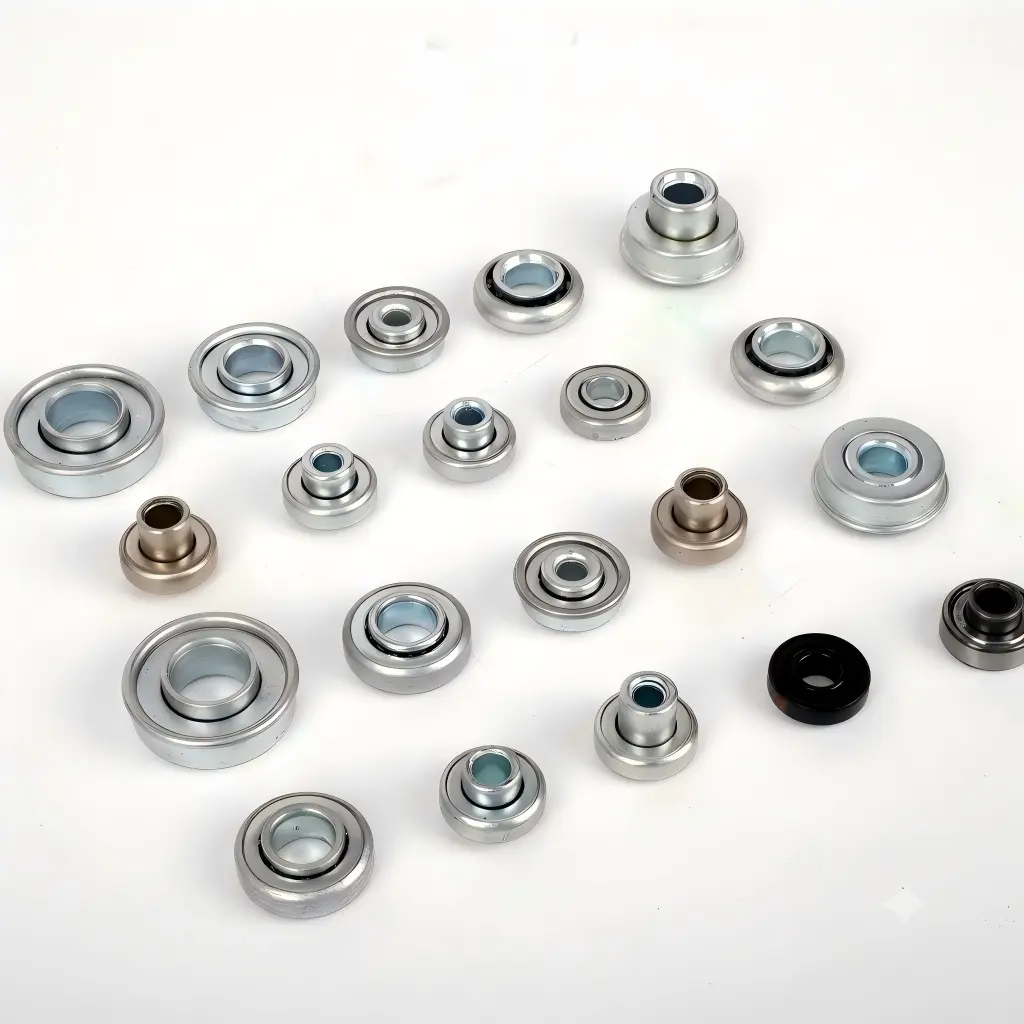
QC Evidence Importers Should Request
| Inspection item | Useful evidence |
|---|---|
| Bore, OD and width | Dimension record referenced to the approved drawing |
| Groove or rolling profile | Profile measurements and comparison with rail/sample |
| Flange and hub | Critical dimension check and installation review |
| Rotation | Agreed functional check with result recorded |
| Surface and visible condition | Inspection photos or approved visual standard |
| Assembly fit | Trial in bracket, rail or customer-provided fixture |
| Packaging | Unit pack, label, carton quantity and pre-shipment photos |
If load rating, service life, noise or corrosion performance is important, define the test method, sample quantity and acceptance threshold. “Heavy duty,” “quiet” and “wear resistant” are marketing phrases unless tied to an agreed evaluation.
How a Clear Specification Supports Buyer Margin
A low unit price does not protect margin when parts require sorting, fail to fit the rail or generate dealer returns. A verified drawing and sample help reduce those hidden costs. Stable model naming, packaging and carton identification make warehouse handling easier. For a private-label brand, a market-specific roller profile can broaden the repair range and create a less interchangeable offer.
OEM RFQ Checklist
- Front, side and installed photos
- Bearing code and visible marking
- Bore, finished outside diameter and total width
- Groove count, width, depth, pitch, radius or angle
- Flange and extended-hub dimensions
- Rail drawing, section dimensions or physical sample
- Application, working conditions and inspection method
- Expected quantity, destination market, label and packaging
Frequently Asked Questions
Can a U-groove roller run on a V-shaped rail?
It should not be assumed. Groove and rail contact must be checked from the section geometry and validated in the assembly.
Is the bearing code enough to reproduce a sliding-door pulley?
No. The completed roller needs its own outside diameter, width, groove, flange or hub, material and track specification.
Can you develop a roller from a physical sample?
Yes, subject to technical review. Sending the sample with the matching rail or bracket provides a better basis for measurement and testing.
Should I request a load or life test?
If those properties are important, state the working condition, test method and acceptance requirement in the RFQ.
Can OEM labels and packaging be added?
They can be reviewed after the product specification, expected quantity and artwork requirements are confirmed.
Developing a Replacement or OEM Track Roller?
Send the roller and rail drawings, measured sample photos, bearing requirement, application, quantity and packaging. We will review the complete assembly before preparing a quotation.