
A brush weatherstrip order is ready for production when the profile fit, pile construction, measurement method and packing are agreed together. Matching a nominal width is only one part of approval. This guide helps importers, window fabricators and private-label buyers turn a trial sample into a repeatable purchase specification.
First confirm whether the application uses a groove-in seal, a fin-pile seal or an adhesive-backed strip. If you are still choosing the construction, start with the brush-seal fit and clearance guide.
Build a Sample Specification Before Asking for a Price
| Approval item | What to record | What to compare |
|---|---|---|
| Installation | Profile cross-section, groove or bonding surface and insertion direction | The actual frame and mating surface, not a product photo alone. |
| Dimensions | Backing width and thickness; pile height and total height separately | A drawing showing where each measurement starts and ends. |
| Construction | Straight pile or centre fin; treatment and colour | The selected sample, including fin position and height where used. |
| Working conditions | Gap along the travel path, movement, dust, moisture and temperature | Fit and sliding resistance on the intended assembly. |
| Order unit | Metres, rolls or retail packs; roll length and packing count | The same unit in the quotation, order and carton label. |
For an insertion channel, review the groove-in brush seal range. If the project needs a central barrier, use the fin-pile weatherstrip specification and record fin geometry separately from pile height.
Keep Common Sizes and Approved Dimensions Separate
Commercial catalogues use several backing-width and height families. Metric values near 4.8, 5.8, 6.8/6.9 and 7.8mm may reflect different exact dimensions or inch-derived catalogues. Do not round a measured groove or substitute a nearby width without checking retention and insertion. A nominal width × height label must state whether height includes the backing.
Common-size references help identify a candidate; the approved drawing and sample control the actual order. Specify any tolerance that matters rather than assuming that all seals share one backing thickness or height tolerance.
Approve the Seal on the Actual Profile
- Record the frame and seal identification and the date of the trial.
- Measure groove or bonding width, backing thickness and working gap at several representative positions.
- Install a sample using the intended method. Check retention, continuity of contact and movement through the full travel.
- For fin pile, check that the fin remains in the intended position without excessive drag or folding.
- For adhesive-backed material, use the actual clean, dry substrate and agree the preparation, application and evaluation conditions.
- Keep an identified approved sample and drawing revision with the order record.
A flat bonding surface calls for a different review from an insertion channel. Compare the 5mm / 7mm self-adhesive brush strip and validate adhesion and frame movement together. Colour alone does not establish silicone treatment, adhesive grade or weather performance.
Define Roll and Carton Packing for Your Sales Channel
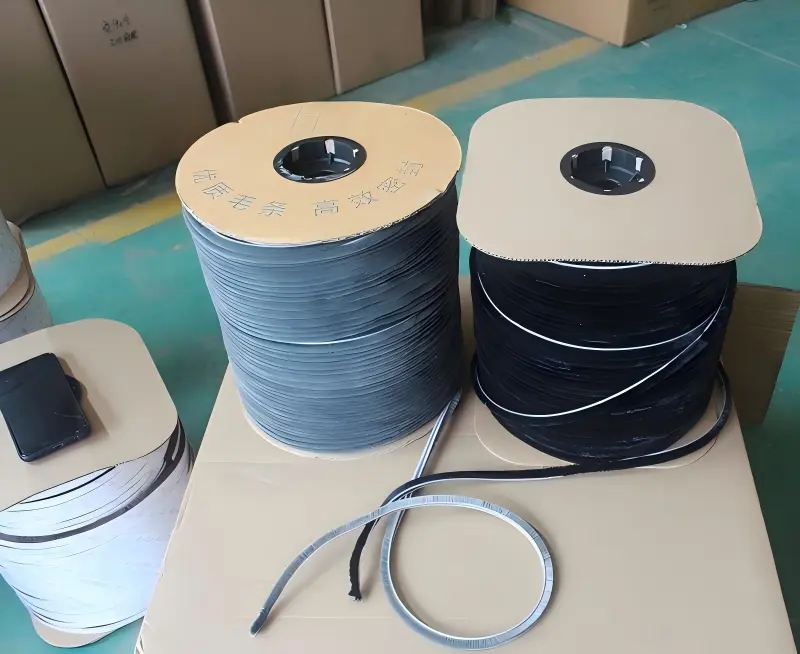
Agree roll length, winding direction, reel or core arrangement, maximum roll size and protection against pile deformation. Carton quantity should follow the actual section size, roll format and handling limit. Avoid carrying a generic rolls-per-carton figure from one model into another.
- Factory feeding: specify the required feed direction, reel dimensions and identification for each construction.
- Distributor stock: identify width, height convention, colour, treatment and batch on each roll and carton.
- Retail or private-label packs: approve cut length, quantity, artwork, barcode and installation description.
Confirm the commercial unit: a price per metre, per roll or per carton cannot be compared until the contained quantity is clear.
Agree Inspection Evidence for the Ordered Model
A practical release record can include critical dimension readings, sample-fit photos, appearance and pile checks, roll-length checks and label/carton photos. Define the measuring method, sample quantity and acceptance criteria before production. Retain the approved reference so later batches can be compared consistently.
Air leakage, water penetration, acoustic performance, ageing or adhesive durability require the relevant assembly, method and acceptance threshold. A simple fit trial does not certify these properties. Request model-specific evidence when the project requires it.
Prepare the Next Repeat Order
Reference the approved drawing revision, sample code, colour, treatment, roll format, carton mark and quantity. If the profile, material or packaging changes, identify the change and decide which checks need repeating. This is particularly useful for importers holding several similar-looking widths and heights.
For mixed brush and compression-profile enquiries, use the window seal sourcing and fit-review page. The Brush Seal selection table compares the four procurement routes.
Request Sample and Packing Review
Send the profile drawing or measured sample, installation photos, construction, colour, dimensions, quantity, destination and packing brief. Qingdao Gleam Hardwares will review the proposed specification and identify the sample, tooling or validation requirements before quotation.