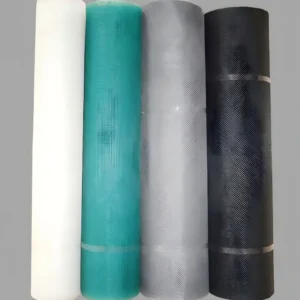
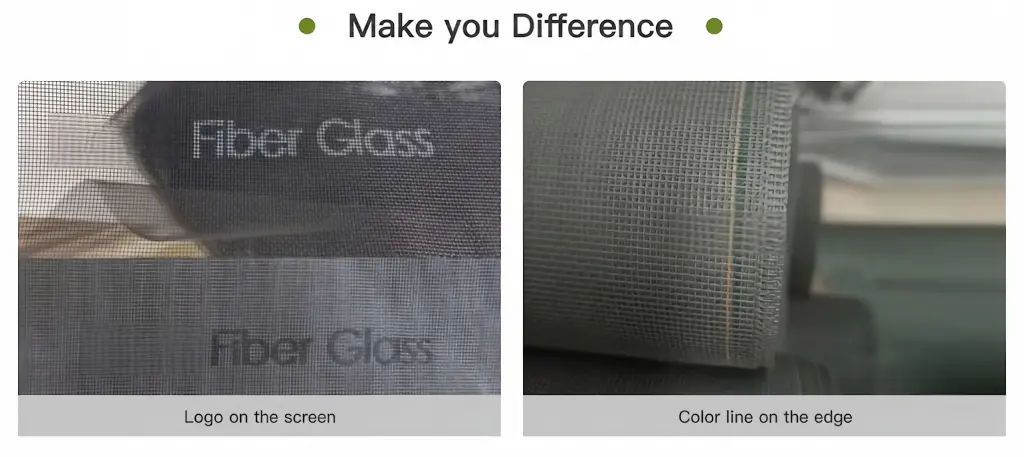
Custom-printed fiberglass screen mesh with colored selvedge gives distributors and screen fabricators a way to identify their roll material during supply, cutting and installation. The illustrated mesh carries printed lettering and colored edge lines. For your order, the wording, placement and edge treatment are developed from an approved artwork brief and physical sample.
This range is designed around product identification and presentation. Agree how the marking will look on the full roll and on a cut screen panel, so branding remains useful without creating an unwanted line across the customer’s view.
Plan the marking around the finished screen
Start with the usable panel, not the roll label. A mark placed near the roll edge may be trimmed away, concealed in a frame or visible on the installed screen. A repeated mark across the mesh may appear several times on a large panel. Give us your cutting layout or a sketch of the finished visible opening so these results can be reviewed before sampling.
Specify the printed side, reading direction, distance from the edge and repeat interval along the roll. For a colored selvedge or edge stripe, state which edge is required and whether its width counts toward the ordered usable cloth width.
Base cloth and identification specification
Common base-cloth references help start the enquiry. The finished printed mesh is approved as a complete product, including its edge treatment, appearance and agreed weight tolerance.
| Item | Options or information to confirm |
|---|---|
| Base material | PVC-coated fiberglass insect screen mesh |
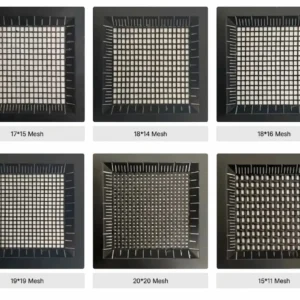
| Conventional base cloth | 18 × 16 per linear inch; nominal 0.28 mm finished yarn; reference fabric weights of approximately 110–115 g/m² |
| Fine-mesh base cloth | 20 × 20 requirements reviewed separately with the selected yarn diameter and GSM |
| Printing | Approved wording or artwork, size, color, side, position and repeat interval |
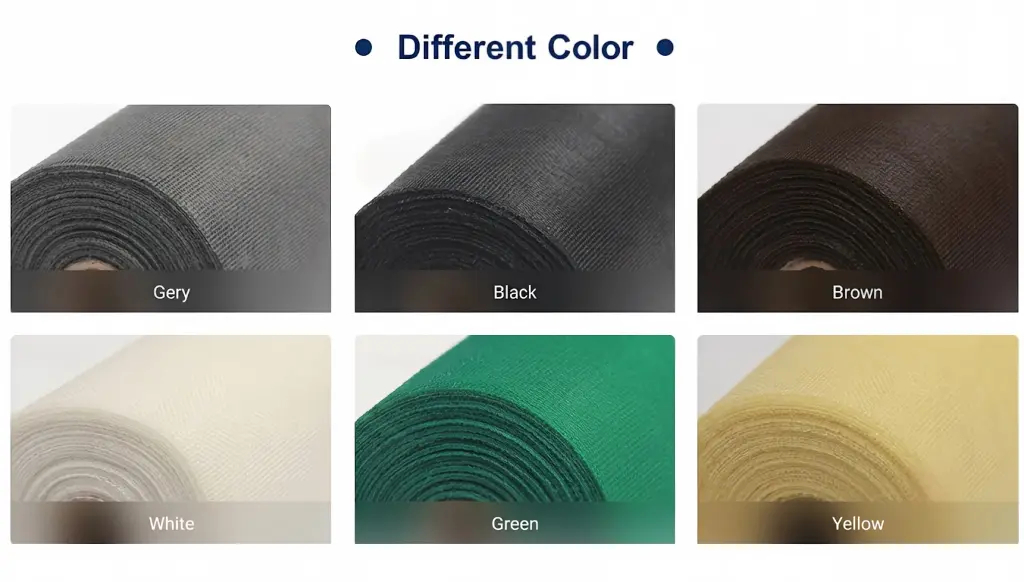
| Colored edge identification | Color reference, stripe or selvedge width, one or both edges, distance from the usable area |
| Roll dimensions | Specify total width, usable width and exact length; standard or special sizes by enquiry |
| Packaging identification | Roll label, specification code, batch reference and carton marks as agreed |
| Supply scope | Printed mesh roll material; frames and fixing accessories are not part of the illustrated product |
Base-cloth references: JWFG 18 × 16 fiberglass screen data and Bash-Tec mesh catalogue, page 5. These describe conventional unprinted constructions, not measured values for the photograph.
Artwork approval before bulk production
- Send the brief. Provide editable artwork where available, a color reference and a placement drawing. Tell us whether the marking is for brand display, specification identification or cutting guidance.
- Review the layout. Confirm lettering size, repeat distance, edge clearance and how the mark appears when the mesh is cut to your panel sizes.
- Approve a physical sample. Examine legibility, color and print coverage against both light and dark backgrounds. Trial-fit a panel when the marking could be visible after installation.
- Record the agreed version. Keep the approved artwork revision and cloth specification together with the sample, so repeat orders refer to the same requirements.
Fine lettering may reproduce differently on an open weave than on a solid label. Printing also covers part of the fabric locally. Review the actual mesh sample rather than approving the design only from a screen image.
Use identification to make mixed orders clearer
Distributors handling several roll widths or mesh constructions can specify a consistent marking plan. For example, an agreed edge color can identify a product family while the roll label records its full specification and batch. Choose the system before ordering; a colored line alone does not establish mesh count, material or quality grade.
Match the packaging record to the cloth: artwork revision, base mesh, roll dimensions, quantity and batch reference should remain connected. Discuss protective wrapping, core requirements and carton marks with the order so the marking stays legible during handling.
Questions before ordering
Will the printing be visible on the installed window?
That depends on the position and your cutting and framing layout. State whether the mark should remain visible, sit within the edge allowance or be removed during cutting. Confirm the result on a sample panel.
Can the same artwork be used on standard and fine mesh?
It can be reviewed for each construction, but the same design may print differently as the opening and yarn diameter change. Compare our standard fiberglass roll mesh and fine-mesh fiberglass screening, then approve the relevant printed sample.
What information is needed for a quotation?
Send the base-cloth specification, roll size, order quantity, artwork, print dimensions and repeat interval, edge-color requirements, cutting layout and packaging brief. Sample arrangements, minimum order and production time are confirmed after reviewing the design.
Request a custom-printed mesh quotation · View the window mesh range · Check the cloth specification before ordering