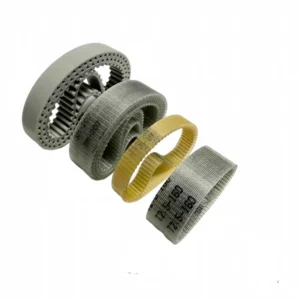
PU Synchronous Belt with Steel Wire Cord
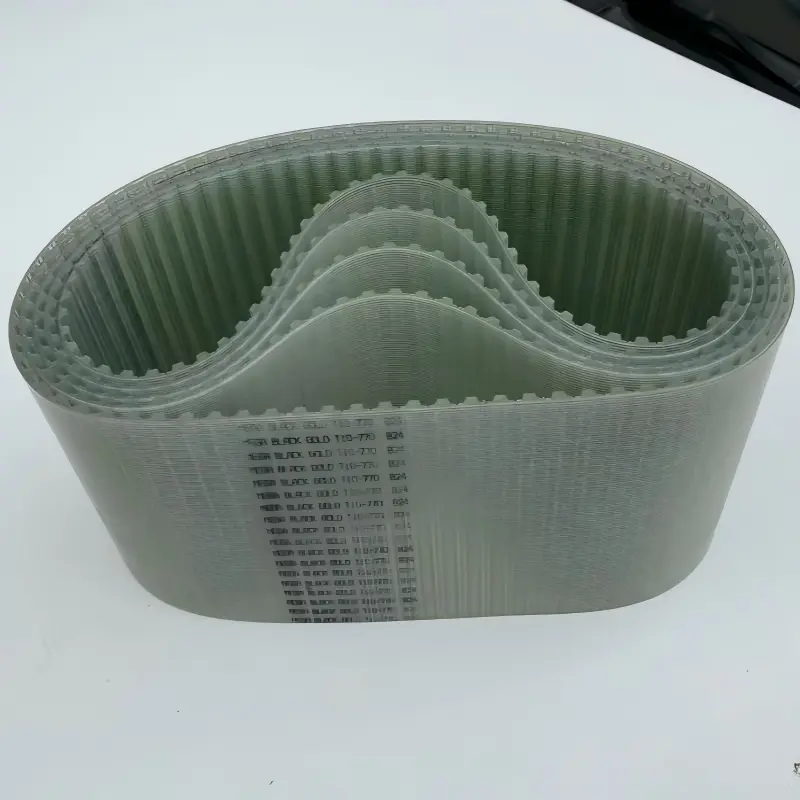
Qingdao Gleam Hardwares manufactures polyurethane synchronous timing belts reinforced with steel tensile cords for industrial transmission and positioning systems. Tooth profile, belt width, pitch length and optional processing are supplied against an approved specification. Send the existing belt code, drawing or measured sample information for selection and quotation.
Product Specification
| Item | Specification |
|---|---|
| Product type | Steel-cord PU synchronous timing belt |
| Belt body | Polyurethane; exact grade confirmed for the application |
| Tensile member | Steel wire cord |
| Available profiles | T5, AT5, AT10, AT20 and HTD 5M, subject to size confirmation |
| Dimensions | Width and pitch length made against belt code or drawing |
| Compatibility | Tooth profile and pitch must match the pulley |
| Applications | Automation, packaging, printing and textile equipment after specification review |
| OEM service | Custom dimensions and approved secondary processing |
Selection Information Required
Please provide the tooth profile and pitch, belt width, pitch length, pulley tooth count or diameter, operating speed and load, working environment, quantity, and any required coating, holes or cleats. If the original belt code is unclear, send detailed photographs and measured dimensions.
Construction Options to Confirm
Open-ended, welded endless and truly endless timing belts are different constructions. The correct option depends on the machine and application. Optional coatings or secondary processing are reviewed separately and should be shown on the approved drawing.
B2B Manufacturing and OEM Support
- Specification review against belt code, drawing or sample
- Dimension and processing confirmation before production
- Sample approval for customized projects
- Packaging and labeling options for importers and industrial brands
Send Your Timing Belt Specification
Share the full belt specification, operating conditions and expected quantity. We will confirm the construction and prepare an OEM quotation after technical review.
Request an OEM Timing Belt Quote
Tooth Profile and Pitch Reference
Specify the complete tooth designation. Equal pitch does not make T, AT and curvilinear profiles interchangeable. The belt tooth shape must match the pulley drawing, including any required clearance and flange arrangement.
| Profile reference | Nominal pitch | Order review |
|---|---|---|
| T5 / AT5 | 5 mm | T and AT tooth forms must be identified separately |
| T10 / AT10 | 10 mm | Confirm the matching pulley geometry |
| AT20 | 20 mm | Confirm machine load, pulley and available construction |
| HTD 5M / HTD 8M | 5 mm / 8 mm | Confirm the curvilinear tooth profile and pulley series |
These are common designation references for a technical enquiry. The established product scope includes T5, AT5, AT10, AT20 and HTD 5M subject to size confirmation; other profiles require a feasibility review. A clear belt code or pulley drawing takes priority over a photograph alone.
Separate Pitch Length, Cut Length and Construction
For an endless belt, pitch length follows tooth count multiplied by pitch. For example, 100 teeth at 5 mm pitch gives a 500 mm pitch length; this is a calculation example, not a listed stock model. For an open-ended belt, state the ordered cut length, clamping allowance and required tooth orientation.
| Construction | Information needed |
|---|---|
| Open-ended roll or cut length | Length, end preparation, clamp arrangement and travel |
| Welded endless loop | Pitch length, joint requirements, pulley and duty cycle |
| Truly endless construction | Continuous-cord requirement and production feasibility |
Do not assume a welded joint and continuous tensile cords provide the same allowable load. Belt selection also depends on acceleration, speed, pulley tooth count, pretension and the working environment. Steel reinforcement limits stretch within a defined design; it does not establish zero elongation or zero system backlash.
OEM Processing and Receiving Checklist
Show holes, backing, cleats and edge processing on a drawing, with the working face and direction identified. State whether the belt contacts oil, cleaners, dust or heat. Compound hardness, operating temperature and chemical compatibility are confirmed for the chosen material; they are not inferred from the PU name.
- Confirm tooth profile, pitch, width, length and construction.
- Record tensile-cord type and any joint or processing requirement.
- Agree dimensional checks, identification and packaging.
- Approve fit on the actual pulley and machine before a repeat programme.
Browse the industrial and window hardware range for related project components, or send a belt code and drawing for technical review.
Page scope: this page covers construction-led enquiries for polyurethane synchronous belts with steel tensile cords. Buyers starting from a known 6 mm or 10 mm replacement width can use the 6 mm and 10 mm width timing belt page, where profile, length and material are then confirmed.
Frequently Asked Questions
Is a round belt the same as a synchronous timing belt?
No. A round belt and a toothed synchronous belt are different products. This page is for polyurethane synchronous timing belts with steel tensile cords.
Can you identify a belt from its code?
Often, but the code should be supported by width, pitch length and profile information. A drawing or sample helps avoid specification errors.
Can the belt include holes, cleats or a surface coating?
Selected processing may be available. Send a drawing showing the required position, dimensions and operating purpose for feasibility review.