
A replacement sliding door trolley needs to fit the sash pocket, run correctly on the rail and carry the intended load as part of the complete door system. A similar photograph, a “13 × 20” label or a heavy-duty description cannot establish those three conditions.
This guide is for importers, hardware distributors and aluminium or uPVC profile fabricators comparing adjustable tandem rollers. It explains what to measure, what to ask the supplier and what to check on a sample before a bulk order.
1. Identify the roller assembly and its role
A tandem sliding door roller normally has two wheels in one carriage or housing. Suppliers also use terms such as double roller, roller carriage and sliding door trolley. In an enquiry, state both the number of wheels in each carriage and the number of carriages supporting each panel.
Confirm whether the assembly supports the panel from below, guides it, or belongs to a suspended system. These arrangements have different load paths and fixing requirements. For a bottom-supported glazed door, include the moving frame and hardware when stating panel mass; the glass weight alone is incomplete.
2. Measure the complete installation envelope
Take front, underside and end-view photographs, then measure the old assembly and the available profile pocket. A ruler photograph helps identify a part; use calipers and a dimensioned drawing for close-fitting interfaces. Record which surfaces each measurement refers to.
| Measurement | What to record | Why it matters |
|---|---|---|
| Housing length | Body length and overall length including projecting ends | An end screw or tab can obstruct the pocket or access hole. |
| Housing width | Body width and maximum occupied width, including rivets, flanges and projections | A narrow body may still have a wider section that prevents insertion. |
| Height | Body height and overall roller height at the permitted adjustment limits | The wheel projection affects panel position and clearance. |
| Wheel size | Outside diameter, tread width and wheel spacing | Housing dimensions do not define these values. |
| Groove | Profile, width, depth and radius where specified | These features must suit the rail head. |
| Fixing points | Hole centres, slots, tabs, screw type and orientation | The replacement must locate and remain secured in the profile. |
| Adjustment | End or side access, tool clearance and usable travel | An adjustment screw must remain accessible after installation. |
| Rail | Cross-section, running-surface material, rail cap and existing wear | The wheel must be selected with its actual running surface. |
Worked drawing example: the Gleam nominal 13 × 20 trolley
The supplied reference drawing shows a 157 mm body length, a 12.5 mm body-width callout, a 20.5 mm body-height callout and a 13.8 mm width callout in the end view. These callouts describe different features. They do not establish a 20 mm wheel diameter or the complete adjustment range.
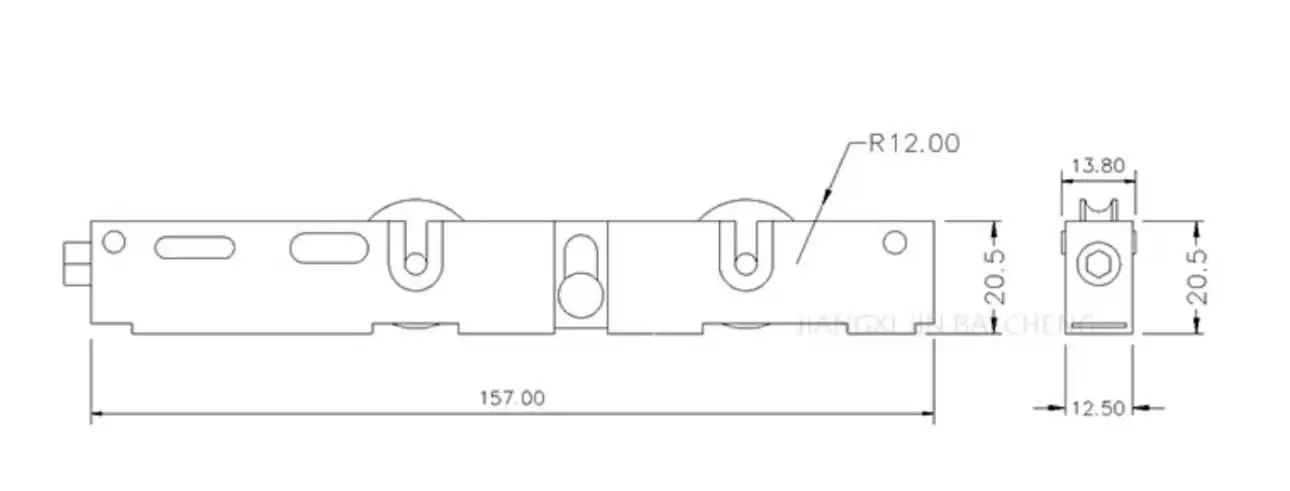
Practical example: if a hypothetical profile pocket has only 13.0 mm clear width at the insertion point, a 13.8 mm-wide section cannot pass through it, even though another part of the housing measures 12.5 mm. Check the drawing and the profile together. Likewise, a radius callout applies to the feature indicated by its leader; it should not be reassigned to the wheel groove.
3. Match the U-groove to the actual track
“U-shaped” identifies a broad profile family. It does not specify a universal rail diameter or groove radius. Compare the groove with the rail-head cross-section, check side clearance and confirm that the wheel sits in the intended running position without housing contact.
Inspect the rail cap or insert as well as the base profile. A cap changes the surface and geometry that the wheel contacts. Dents, a flattened rail head, loose caps or trapped debris can affect operation even when the replacement trolley fits the sash pocket.
Published systems illustrate why this check is necessary: FPL specifies a 5 mm track bead for its particular #295-98 carriage when used with a non-FPL track. That is a requirement for that system, not a dimension to copy to the Gleam trolley. Use the selected assembly’s own rail requirement.[1]
4. Specify wheel material and metal components separately
POM and nylon are material families. Their names help narrow a selection, but the grade, wheel geometry and assembled design determine suitability.
| Item | Useful selection point | What to confirm |
|---|---|---|
| POM / acetal wheel | Low moisture absorption is a useful dimensional-stability characteristic. | Actual resin grade, wheel dimensions and the intended rail/load combination. |
| Nylon / PA wheel | Common grades such as PA66 have useful sliding and wear properties. Moisture uptake can affect dimensions. | PA grade, conditioning state and dimensional requirements in the service environment. |
| Stainless steel housing | The housing specification is separate from the bearing, axle and adjustment screw. | Grade and finish for each relevant metal component. |
| Outdoor installation | Water, salt exposure, dirt and drainage affect the complete assembly. | Environment, material specification, bearing protection and any required test conditions. |
Celanese identifies low moisture absorption as a characteristic of its POM acetal copolymer family. Ensinger notes both PA66 wear properties and its susceptibility to moisture-related dimensional changes. These are material-selection references, not test results for a finished Gleam wheel. Neither material should be declared universally stronger, quieter or longer-lasting without a defined comparison.[2] [3]
For coastal work, review the bearing and wheel construction as well as the housing. TOMMA, for example, distinguishes coastal and non-coastal variants within its own roller range by their component combinations. The procurement lesson is to request the component specification instead of relying on “stainless steel roller” as a complete description.[4]
5. Confirm the bearing code, protection and material
If an enquiry mentions 625ZZ, verify that this is the bearing actually fitted to the offered wheel. Request its dimensional designation, steel material, protection type and lubrication specification. A code mentioned in a reference listing is not confirmation of the selected assembly.
NSK distinguishes shielded bearings from sealed bearings and uses Z/ZZ for its shield designations. A shield suffix does not establish a stainless steel grade. Also, a bearing’s catalogue load rating is not the load rating of the completed trolley: the wheel, axle, housing, fixing and track remain part of the load path.[5]
6. Read the load-rating unit before comparing capacity
| Published unit | Clarification required |
|---|---|
| kg per wheel | Is this the individual wheel/bearing value or an assembled test result? |
| kg per trolley / carriage | How many wheels, on which rail and at what permitted adjustment? |
| kg per pair | Does “pair” mean two complete carriages? What spacing and panel arrangement apply? |
| Maximum door-panel mass | Which roller quantity, rail, profile and operating/test conditions support this value? |
For example, FPL describes its #3946 capacity in terms of a door panel supported by two carriages. A value expressed this way should not be compared directly with a per-carriage number. The basis and conditions belong with the rating.[6]
Illustrative load-sharing example: a stationary 100 kg panel supported by two carriages would place the equivalent of 50 kg on each only in an ideal centred arrangement with no other vertical support. If the centre of mass is 60% of the distance from the left support toward the right, simple static equilibrium gives 40 kg-equivalent on the left and 60 kg-equivalent on the right. These are illustrative reactions, not a trolley selection or a door approval.
Real selection must account for the actual load distribution, rail alignment, adjustment position and operating conditions. Obtain the assembly/system supplier’s applicable rating and test basis. There is no single safety multiplier that can be applied to every roller design.
For the Gleam options below, state your required panel mass and load-rating unit in the enquiry so the selected configuration can be confirmed. This guide does not assign a tested maximum capacity to the photographed assembly.
7. Approve a sample on the intended profile and rail
- Fit: check insertion, fixing points, housing clearance and access to the adjustment screw.
- Position: confirm the permitted adjustment range, panel height, wheel seating and engagement of the system’s guides or retainers.
- Operation: assess movement over the full travel with the intended panel load; check closing alignment and latch engagement.
- Service requirement: agree any cycle test, operating-force limit, corrosion requirement and acceptance criteria before bulk supply.
- Approval record: retain the drawing revision, material/bearing specification and approved sample identification.
Follow the door-system supplier’s installation instructions. A screw’s turning direction, adjustment travel and panel-removal procedure are design-specific. For an existing heavy glazed panel, use the installer’s approved handling procedure rather than treating this selection checklist as removal instructions.
8. Separate a worn roller from a track or alignment problem
| Observed symptom | Checks before ordering replacements |
|---|---|
| Door drags along most of its travel | Check rail cleanliness, roller rotation, panel clearance and adjustment. |
| Door catches repeatedly at one location | Inspect that section of rail for damage, debris or a loose cap. |
| Latch alignment changes after adjustment | Check panel position and closing alignment before altering the locking hardware. |
| New roller rubs inside the pocket | Recheck maximum width, projecting fixings and available height. |
| Rust appears despite a stainless housing | Identify the affected bearing, axle, screw or other component and confirm its material. |
These symptoms are starting points for inspection, not diagnoses. Door manufacturers’ maintenance guidance commonly includes keeping the sill clean and checking roller adjustment. Use the applicable system instructions for cleaning and lubrication rather than assuming one lubricant suits every assembly.[7]
9. Compare the two Gleam trolley options
The following pages provide two wheel-material configurations for enquiry. They share a reference trolley image and drawing; select by the specified material and verified installation dimensions.
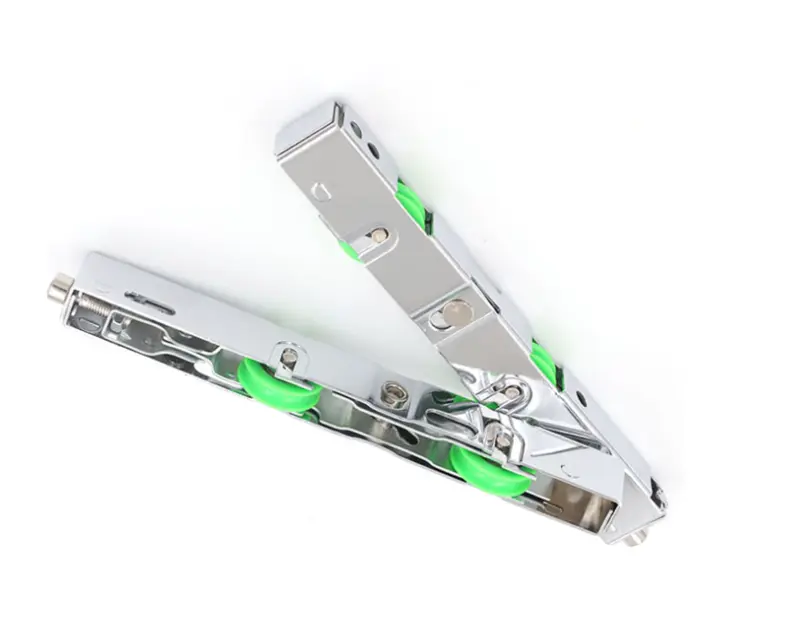
Adjustable POM Sliding Door Trolley 13×20
For enquiries specifying POM wheels and the corresponding housing/profile fit.
Double Nylon Sliding Door Roller
For enquiries specifying nylon wheels and replacement or profile-system matching.
For other carriage or bearing arrangements, browse the sliding door pulley and roller assembly range.
10. Send a quotation request that can be checked
Include: door/profile type; drawing or old-part photographs; housing and wheel dimensions; rail section and material; fixing and adjustment details; POM or nylon grade requirement; bearing and metal-component requirements; moving-panel mass; number of carriages per panel; installation environment; order quantity; and any test or documentation requirements.
Confirm whether the quotation unit is one complete trolley, a pair of trolleys or a loose replacement wheel. Agree packing, required delivery timing and sample approval separately. Free samples are available from Gleam; confirm sample scope and shipping arrangements in your enquiry.
Request a trolley selection and quotation
Frequently asked questions
Does 13 × 20 mm specify the wheel diameter?
For the Gleam trolley example in this guide, 13 × 20 mm is a nominal profile description. The supplied drawing separately shows a 157 mm body length, a 12.5 mm body-width callout, a 20.5 mm body-height callout and a 13.8 mm width callout in the end view. Confirm the wheel diameter and the full installed envelope separately.
Will any U-groove roller fit a rounded sliding-door track?
No. Check groove width, depth and radius against the rail-head profile, together with wheel alignment, housing clearance and the condition of the running surface. Confirm fit on the actual rail or an approved rail sample.
Which is better for sliding-door rollers: POM or nylon?
The appropriate material depends on the polymer grade, rail, clearance, load, environment and required service performance. POM typically has low moisture absorption. Common nylon grades offer useful wear properties but moisture conditioning can affect dimensions. Compare the specified grades and test the assembled roller on the intended track.
Can I multiply a trolley load rating by the number of trolleys?
Do not use that calculation alone to approve a door. First confirm whether the published rating applies to one wheel, one carriage, a pair or a complete door, and obtain the applicable track, spacing, adjustment and test conditions. Load sharing and the rest of the door system also need to be checked.
Does a 625ZZ description prove that the trolley has stainless steel bearings?
No. Confirm the bearing dimensions, material and protection specification separately. ZZ is commonly used for shields on both sides; it does not establish a stainless steel grade. The bearing type fitted to the selected Gleam configuration should be confirmed in the quotation and approved sample.
Technical references
The references support general selection principles. Product-specific dimensions in the worked example come from the supplied Gleam drawing. Other manufacturers’ ratings, materials and certifications do not certify a Gleam product.
- FPL Hardware — #295-98 Stationary Adjustable Roller Kit
- Celanese — Hostaform / Celcon POM acetal copolymer
- Ensinger — TECAMID 66 natural, PA66
- TOMMA — 7000 Series component configurations
- NSK — Deep-groove bearing FAQ on shields and seals
- FPL Hardware — #3946 Tandem Roller
- Marvin — Signature Ultimate and Modern Owner’s Manual