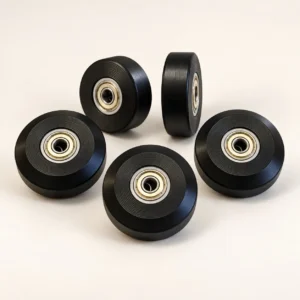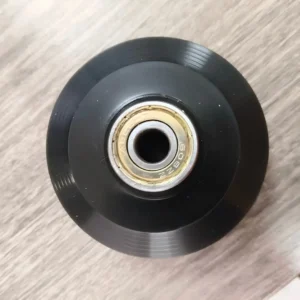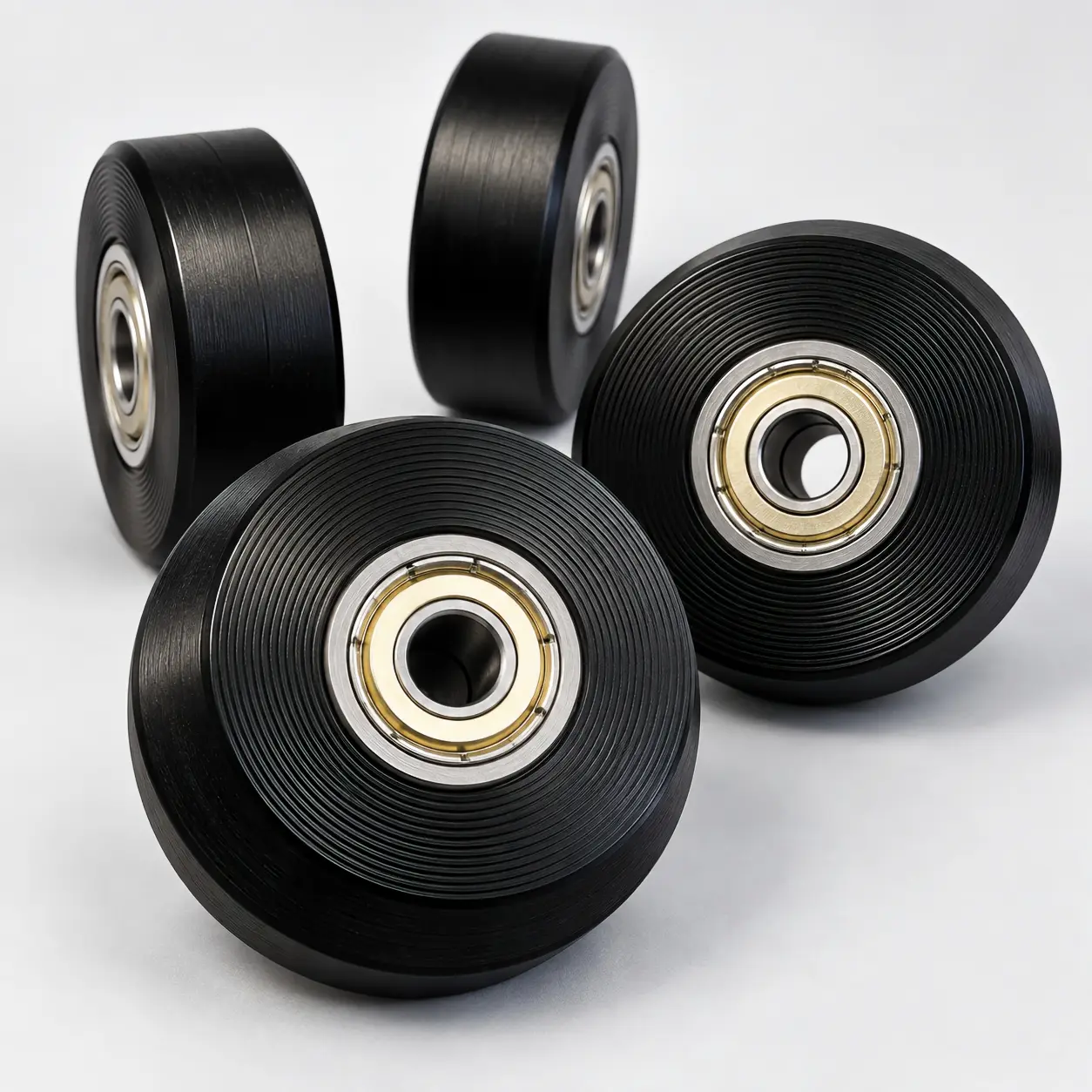
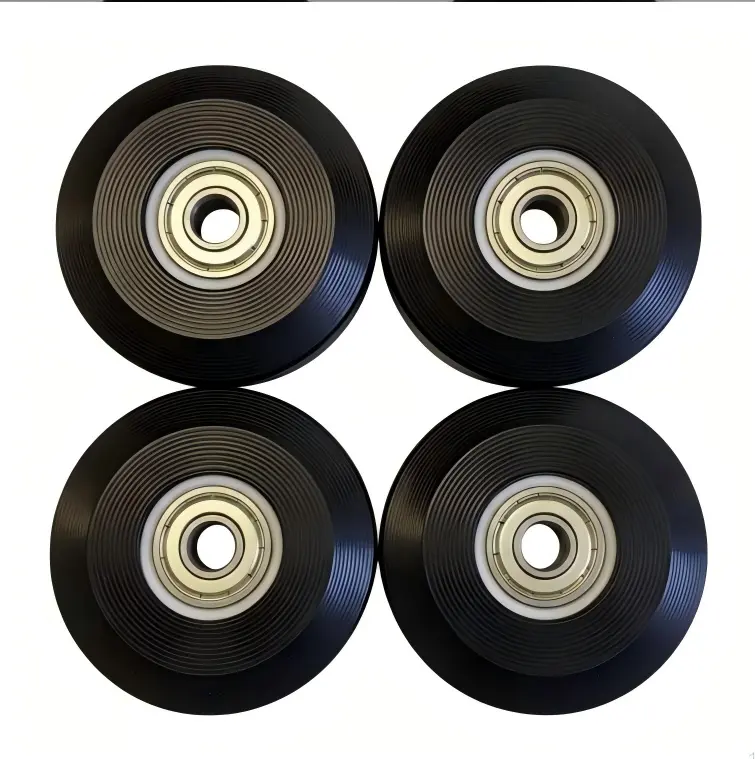
OEM Pilates reformer wheels give equipment manufacturers, spare-parts importers and service networks a controlled way to source carriage rollers, side wheels and replacement wheel kits. Qingdao Gleam Hardwares develops wheel specifications from an original sample, rail drawing or complete dimension sheet instead of treating every black wheel as interchangeable.
The commercial value is straightforward: a clearly identified wheel family helps a distributor stock fewer mistaken variants, reduces compatibility returns and creates a repeat spare-parts line for studios and equipment owners. We can review private-label packing, model labels and mixed replacement kits after the fit is confirmed.
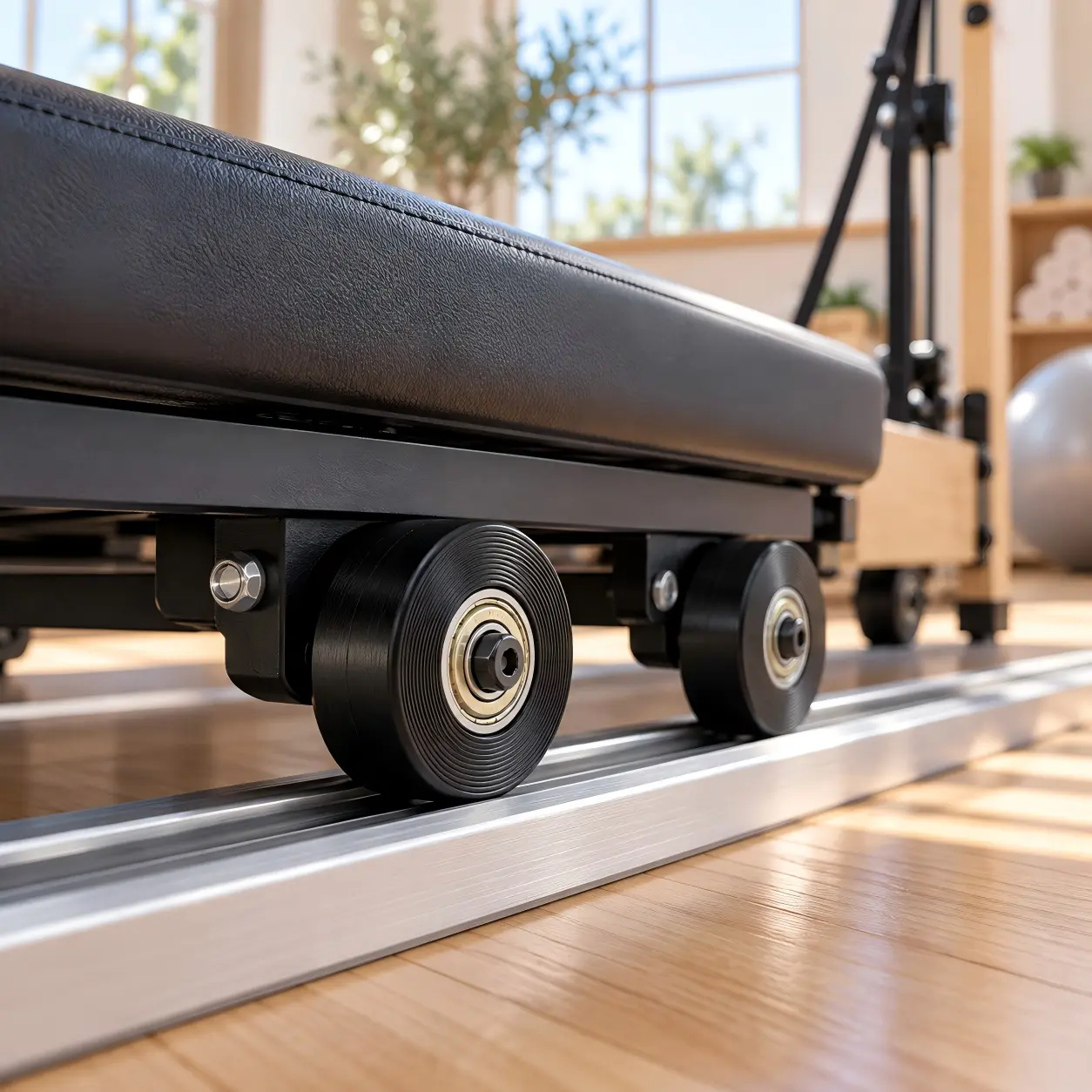
OEM Pilates Reformer Wheel Specification Matrix
| Specification point | Common RFQ reference | What must be confirmed |
|---|---|---|
| Wheel function | Carriage rolling wheel, side guide wheel or additional transport wheel | Machine position and rail/contact geometry |
| Diameter options | 52, 57, 58, 59 and 72 mm are common project references | Actual outside diameter and tolerance from drawing/sample |
| Wheel width | 18–24 mm reference range | Running surface, hub width and available frame clearance |
| Material | Cast PU; engineering plastic or rubber for selected duties | Noise, wear, compression and floor/rail requirements |
| Hardness | 85A, 90A or 92A Shore A reference options | Test method, tolerance and approved sample |
| Core | Reinforced polymer, aluminum or steel | Static duty, weight target and bond design |
| Bearing | 608ZZ / 608-2RS or custom precision bearing | Bore, axle, spacer, shields/seals and installation stack |
| Preliminary load reference | 50–100 kg per carriage wheel | Final rating requires wheel, core, bearing, mounting and complete-machine validation |
These values are practical starting points for an enquiry, not a universal compatibility or certified load claim. Special hardness, dimensions and load targets can be developed around the equipment drawing and sample-validation plan.
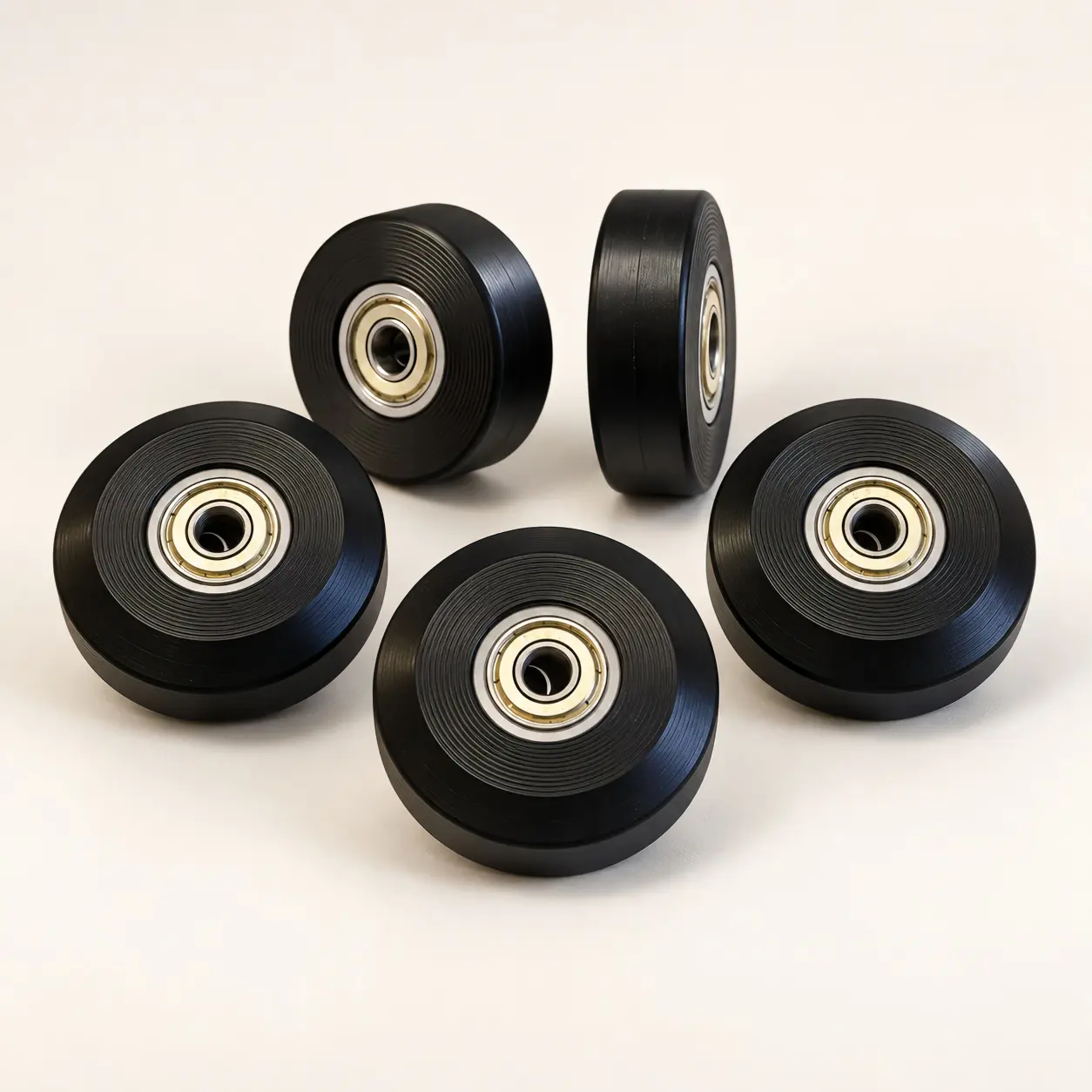
Choose the Wheel by Its Job in the Reformer
Carriage rolling wheels carry the moving platform and normally need stable concentricity, controlled hardness and consistent bearing alignment. Reformer carriage lateral guide wheels control sideways movement and may use a different diameter, profile or preload. Rope pulleys guide the cord and need a groove matched to rope diameter and approach angle. Transport wheels used to move the machine are a fourth, separate function.
We therefore ask buyers to mark each wheel position on a simple machine photo. This prevents a transport wheel or pulley from being quoted as a carriage roller and makes a multi-SKU spare-parts programme easier to manage.
Material, Hardness and Flat-Spot Control
Cast polyurethane is widely requested for Pilates carriage wheels because it can balance rolling comfort, wear and dimensional control. Engineering plastic can suit compact guide or pulley parts where rigidity is more important, while rubber may be considered for selected low-speed or vibration-sensitive duties. Material choice must follow the contact surface, load duration and required service feel.
Harder is not automatically better. A 90A or 92A compound may reduce deformation compared with a softer formulation, but core support, PU formulation, wall thickness, temperature, storage time and wheel loading also affect compression marks. Where flat spots are a concern, define a static-load trial on the complete carriage instead of relying only on the Shore A number.
How an OEM Wheel Programme Supports Your Margin
- Use one approved drawing and golden sample to control repeat orders across several replacement-kit SKUs.
- Offer branded four-, six- or eight-wheel service kits with model identification and installation notes.
- Reduce returns by printing the actual diameter, width, bearing and compatible equipment reference on the label.
- Consolidate carriage wheels, side guides and rope pulleys in one B2B purchasing discussion where practical.
Inspection and Sample Approval
A practical inspection plan can include outside diameter, width, bearing seat, hub/stack width, concentricity, visible runout, hardness, appearance, bearing rotation and pack count. For a load-sensitive project, the buyer and supplier should also agree the static dwell time, wheel count, rail setup and acceptance condition after recovery. Noise evaluation should state speed, load, rail cleanliness, measuring distance and background noise; we do not apply a fixed decibel promise without an agreed test.
For first approval, send one original wheel or a dimensioned drawing plus photos of the installed assembly. A small fit-and-roll trial can be approved before private-label packaging is finalized.
Related Pilates Wheel Solutions and Guides
- 52mm Pilates reformer replacement wheels
- 58mm metal-core anti-flat-spot wheel programme
- silent Pilates reformer bearing wheels
- custom grooved Pilates reformer rope pulley
- how to choose replacement wheels by measurement
- browse the Pilates reformer wheels and pulleys collection
Frequently Asked Questions
Can you copy an existing reformer wheel?
We can review a physical sample and drawing, but the buyer should confirm that the design may be reproduced and identify any protected brand features. Dimensions, material, hardness and bearing arrangement are approved for the buyer’s project.
Can one wheel fit every commercial reformer?
No. Equipment brands and models use different rails, axles, wheel positions and installation stacks. Match the complete geometry before describing a wheel as compatible.
Can special load and hardness requirements be produced?
Yes, feasibility can be reviewed from the target load, wheel count, duty cycle, diameter, width, core and test method. The final value is confirmed through the agreed sample and assembly test.
Can you make private-label replacement kits?
Yes. After the wheel specification is approved, discuss set quantity, spare parts, model label, barcode, instruction insert and export carton.
Build a Pilates Wheel Range Around Verified Fit
Send the original sample or drawing, wheel position, dimensions, bearing/axle details, expected order quantity and packaging plan. We will organize the technical review for an OEM quotation.