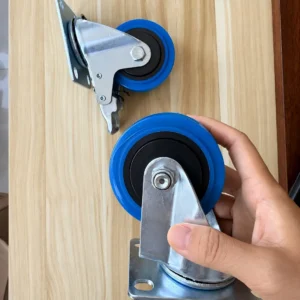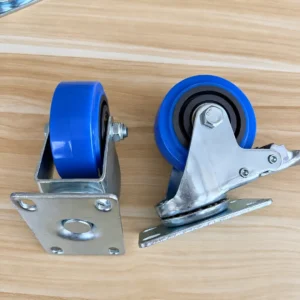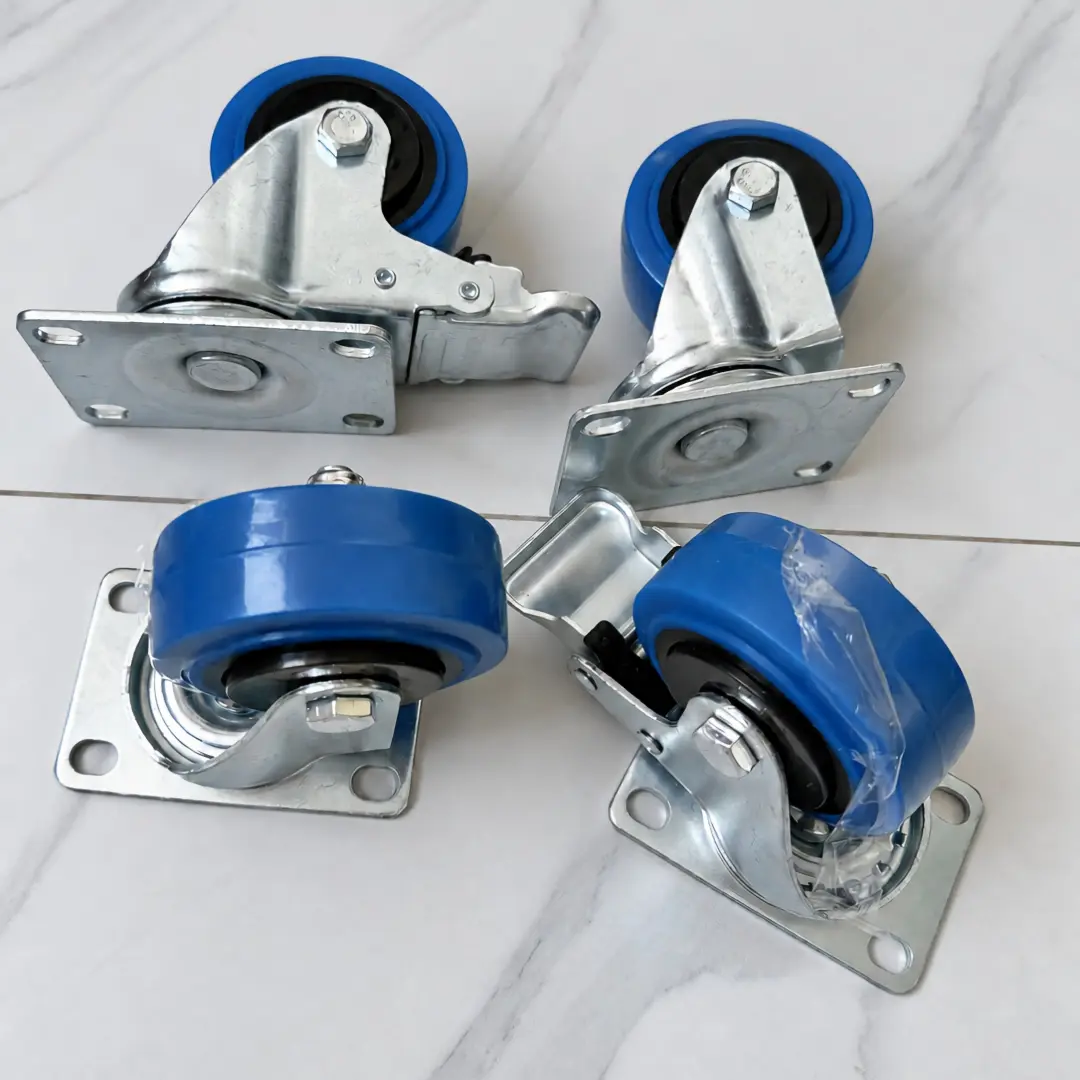
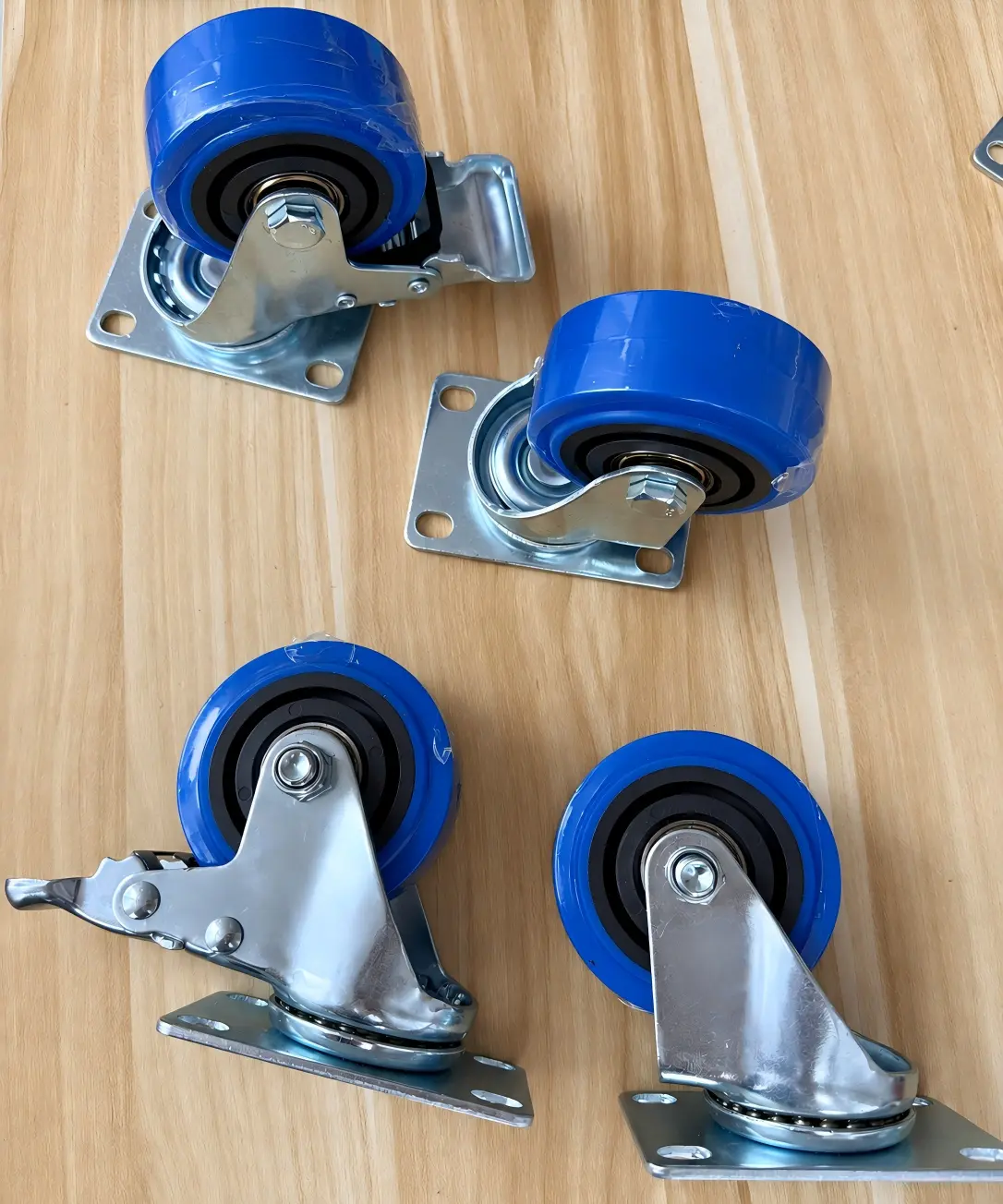
Free-Swivelling Movement for Frequently Repositioned Equipment
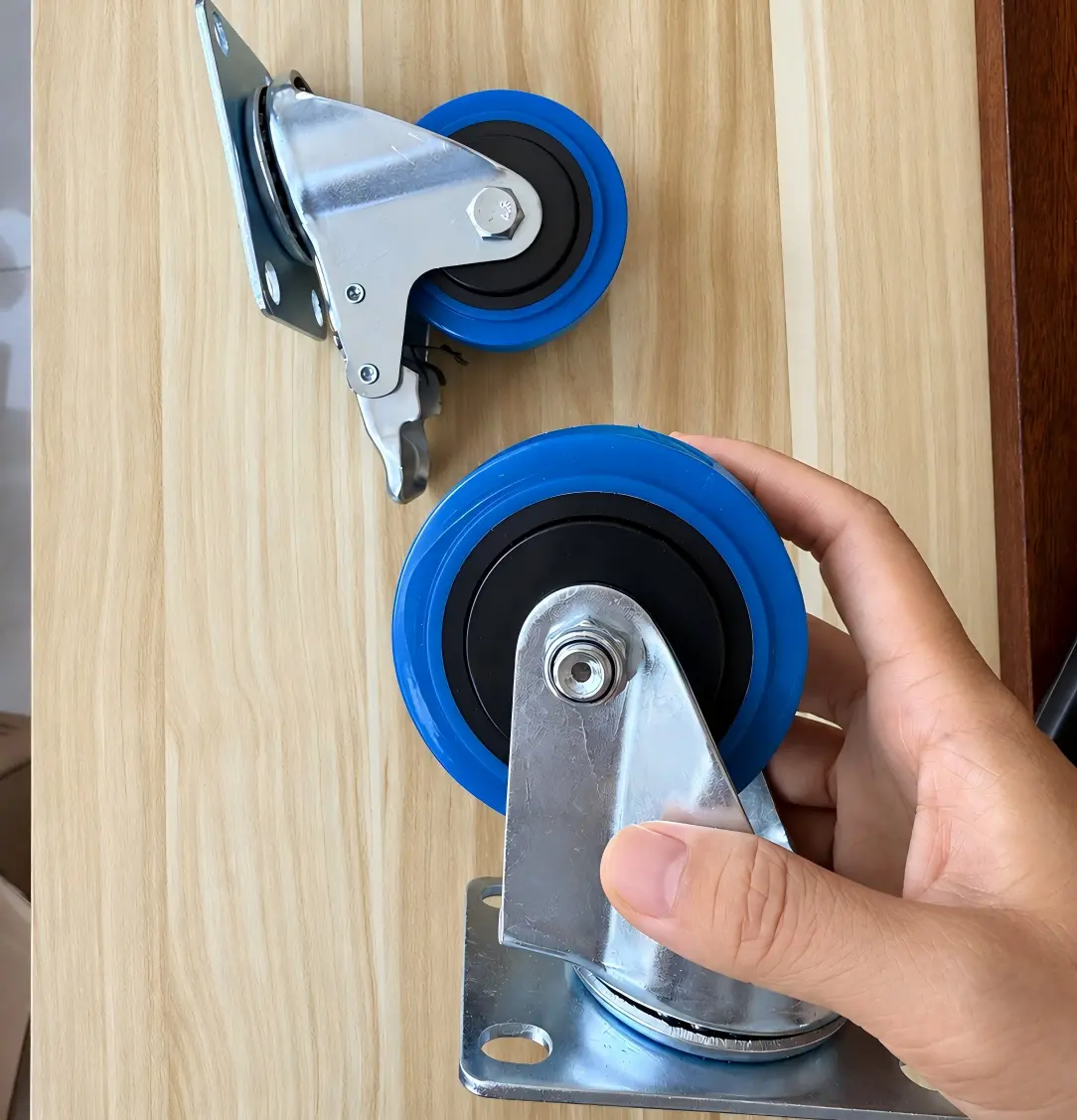
These blue TPR swivel plate casters are the unbraked configuration in our thermoplastic rubber range. They suit equipment builders and distributors who want easy changes of direction, a resilient tread and a quieter rolling experience for hand-pushed trolleys. Typical projects include hotel service carts, indoor tool carts, display furniture, instrument stands and industrial transport equipment.
TPR is a useful upgrade when buyers place greater value on rolling comfort, floor contact and perceived product quality. It can also serve everyday cart applications when the budget allows. Start with the wheel diameter and mounting pattern, then select a bearing and bracket combination that supports the actual working load. The material name alone does not determine capacity.
Choose This Configuration When the Cart Must Turn Freely
- A four-hole top plate can be secured to a flat, reinforced equipment base.
- The trolley needs a universal swivel wheel to manoeuvre around work areas or change direction in a narrow aisle.
- A separate parking arrangement is already specified, or braked casters will be installed at other positions.
- The project needs a common blue wheel appearance across matched fixed, swivel and braked components.
For a parking function, choose TPR swivel casters with brake. For straighter travel on a flatbed or handcart, combine the swivel positions with rigid TPR plate casters of the same installed height.
Common Diameter and Tread-Width Options
Common market dimensions can be produced, and special sizes can be developed from your sample or drawing. The dimensions below are ordering options, not measurements taken from the photos. Confirm the complete assembly drawing, load rating and mounting fit before approving an order.
| Ordering size | Common tread width | Starting application |
|---|---|---|
| 3 inch / 75 mm | 32 mm | Compact trolley and equipment layout |
| 4 inch / 100 mm | 32 mm | General trolley, commercial furniture and case projects |
| 5 inch / 125 mm | 32 mm | More wheel clearance for frequent movement |
Inch labels are common trade names. Specify the required diameter in millimetres: 3, 4 and 5 inch products may be offered as 75, 100 and 125 mm, or as exact imperial dimensions. These are not automatically interchangeable.
| Specification | What to put on the purchase drawing |
|---|---|
| Wheel construction | Blue TPR tread with a plastic wheel centre; confirm core polymer, tread profile and colour sample. |
| Mounting | Steel top plate; confirm plate length × width, bolt-hole centres, hole or slot size and swivel offset. |
| Bearing selection | Double ball bearing, single bearing or other agreed hub arrangement; state axle bore, spacer and bearing protection. |
| Finish | Zinc-plated steel configuration can be specified; identify any corrosion-resistance requirement separately. |
| Load and movement | Required load per caster, loaded cart weight, floor route, speed and operating frequency. |
| Other sizes | 2.5 inch / 63 mm and 3.5 inch / 90 mm dimensions can be reviewed; larger 6 or 8 inch projects require a separately matched bracket. |
Plastic Core, Double Bearings and Quiet Operation
When requesting an elastic rubber swivel caster for an industrial trolley, identify whether “double bearings” means two wheel-hub bearings or two ball raceways in the swivel head. They perform different jobs. A single wheel can use two hub bearings; this is not a twin-wheel or double-axle caster. Include the bearing arrangement in your bill of materials so repeat orders stay consistent.
Buyers also use terms such as silent TPR wheels, mute casters and noiseless trolley wheels. The useful acceptance criterion is low noise on the intended floor with the equipment loaded. Wheel compound, bearing fit, fork rigidity, swivel clearance and floor joints all affect the result. Agree a sample rolling check instead of relying on a “silent” label.
OEM Ordering Details
Provide quantities by diameter and configuration, the number of casters per trolley, your mounting drawing and any marking or packing requirements. Identify whether axle hardware, plate fixings and replacement wheels belong in the supply scope. For warehouse racks or a shelf on wheels, include the highest loaded centre of gravity and the route between workstations.
Buyer Questions
Can an unbraked caster be supplied in a heavy-duty specification?
High-load requirements can be reviewed against the wheel, bearing, bracket and mount as a complete assembly. Submit the required working load and service conditions; a larger or reinforced assembly may be necessary.
Is a 100 × 32 mm wheel enough to identify the correct caster?
No. It describes wheel diameter and width. Two 100 × 32 mm swivel casters can have different top plates, installed heights, bearings and rated loads.
Can we order a flat blue wheel or a different tread profile?
Specify the tread profile, colour and reference sample with the dimensional drawing. “Flat blue” and supplier codes such as W18 should be accompanied by a drawing, because those descriptions do not establish an interchangeable model.
Related Configurations and Buying Guidance
- Compare the TPR caster wheel range
- Add a braked swivel position
- Match a fixed-direction position
- Specify quiet casters for hospitality and equipment carts
- Check TPR sizes and load requirements
Request a Configuration-Matched Quotation
Send diameter, width, plate pattern, installed height, bearing preference, load target and order quantity. Tell us where the trolley will operate and whether you need matching braked or fixed casters.