
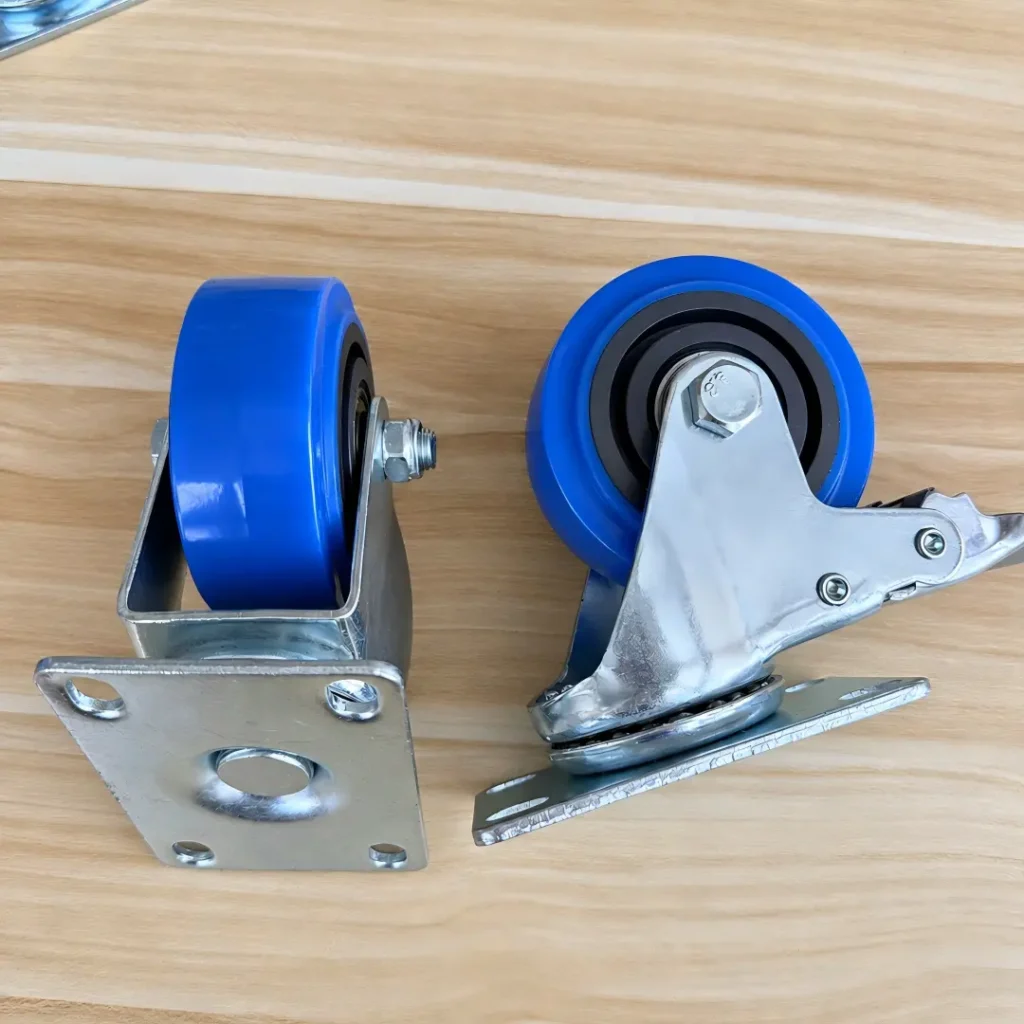
A request for a “4 inch, 330 lbs, double bearing TPR caster” leaves several important questions unanswered. Does 330 lbs apply to one caster or the set? Is the wheel 100 mm or 101.6 mm? Does double bearing mean the wheel hub or the swivel head? Answering these questions before comparing quotes prevents fit and capacity errors.
This guide covers dimensional and load selection for TPR caster projects. It complements the TPR configuration range and the existing general industrial caster selection guide. The worked example below is a planning example, not a published rating for the photographed products.
1. Separate the Wheel Dimensions from the Caster Dimensions
| Dimension | What it describes | Typical mistake |
|---|---|---|
| Wheel diameter | Outside diameter of the running wheel | Treating 100 mm and exact 4 inch / 101.6 mm as identical |
| Tread width | Width of the wheel’s running surface | Confusing it with hub length or overall fork width |
| Axle bore and hub length | Fit of the wheel between the fork legs and on the axle | Ordering a wheel that has the right diameter but cannot fit the old bracket |
| Installed height | Distance from the mounting seating surface to the floor | Using wheel diameter as the complete caster height |
| Mounting pattern | Plate size, hole centres and hole/slot dimensions, or the full stem specification | Assuming all European mounting dimensions are the same |
| Swivel and pedal envelope | Space occupied as the caster turns and the brake is operated | Discovering that the pedal collides with a frame tube |
2. Use Inch Names as a Starting Point, Then Approve Millimetres
| Common buying term | Metric size to confirm | Useful specification note |
|---|---|---|
| 2 inch caster wheel | 50 mm or 50.8 mm | Specify exact diameter and compact mounting dimensions |
| 2.5 inch caster wheel | 63 mm or 63.5 mm | Confirm the original wheel and hub fit |
| 3 inch TPR wheel | 75 mm or 76.2 mm | 75 × 32 mm is a common metric request |
| 3.5 inch wheel | 90 mm or 88.9 mm | These are distinct dimensions |
| 4 inch TPR caster | 100 mm or 101.6 mm | A 100 × 32 mm wheel still needs a mounting drawing |
| 5 inch TPR caster | 125 mm or 127 mm | Check installed height and brake access |
| 6 inch wheel family | 150, 152.4 or 160 mm | Do not substitute between nominal catalogue families |
| 8 inch caster wheel | 200 mm or 203.2 mm | Specify the actual diameter and larger assembly dimensions |
Gleam can produce common market dimensions and review special sizes from samples or drawings. This table groups common purchasing language; it is not a statement that every listed metric diameter shares one bracket or load rating. Widths such as 32 mm or 40 mm belong to particular wheel sections, not automatically to every wheel in a diameter group.
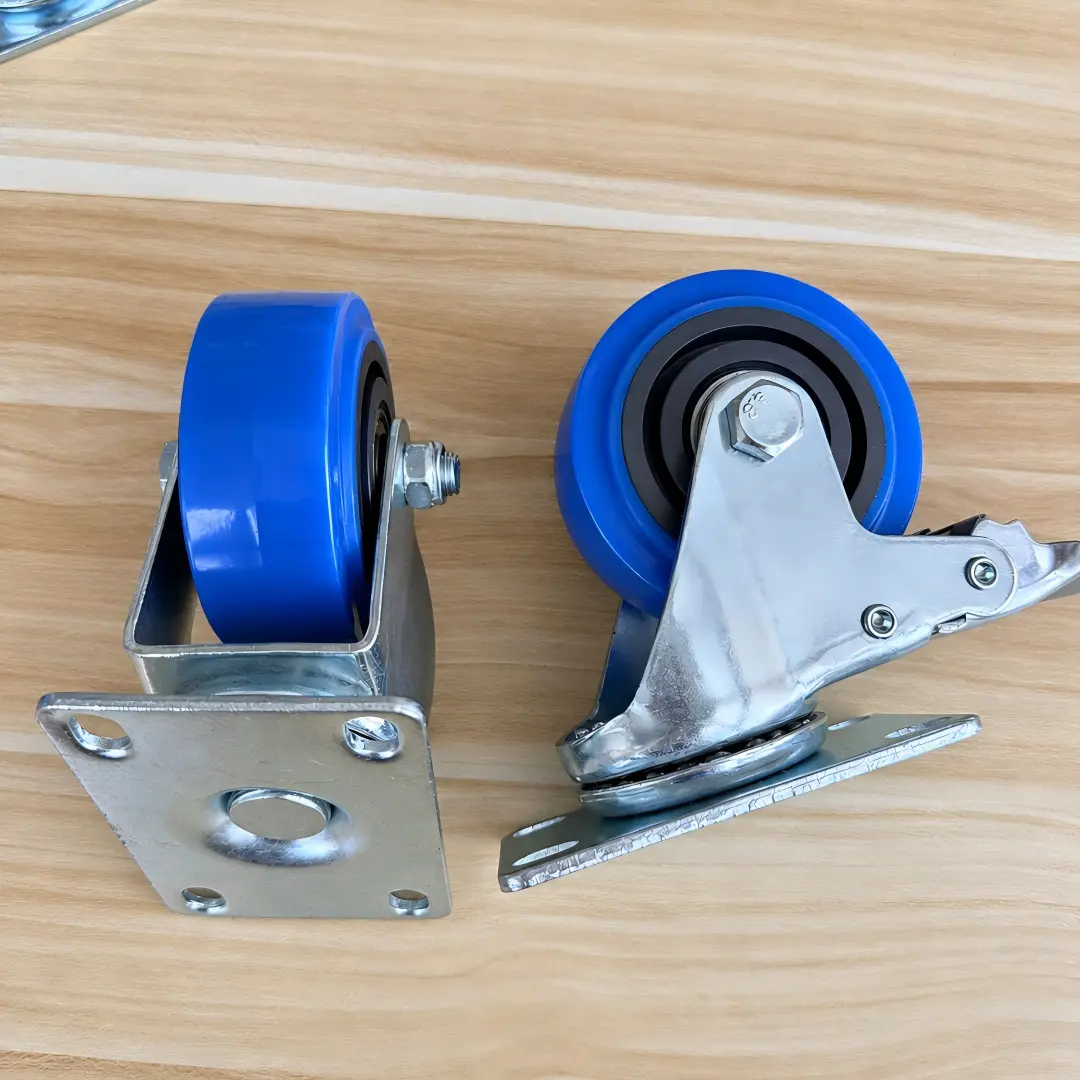
3. Calculate a Required Capacity Before Selecting an Assembly
The load request starts with the equipment’s empty weight plus its maximum payload. Divide that total by the number of casters expected to support the load under the specified conditions, then apply an appropriate allowance for the actual service. Uneven floors and load distribution can mean that all four casters do not carry equal loads.
Planning relationship: required capacity per supporting caster = (equipment weight + maximum payload) ÷ effective supporting casters × agreed service factor.
| Illustrative input | Value |
|---|---|
| Empty trolley | 80 kg |
| Maximum payload | 280 kg |
| Loaded total | 360 kg |
| Supporting casters assumed for the example | 3 |
| Example service factor | 1.25 |
| Calculated requirement | 360 ÷ 3 × 1.25 = 150 kg per supporting caster |
In this example, 150 kg is approximately 331 lbs, so a buyer may describe a similar target as “330 lbs per caster.” The assumed three supports and 1.25 factor are illustrative; they are not a universal rule or a safety approval. The correct assumptions depend on the frame, load distribution, route, obstacles, movement and applicable requirements.
If your project instead calls for a 200 kg or 250 kg load capacity, submit that requirement with the operating conditions. The quote should identify the assembly that meets the requirement, its test or rating basis and any restrictions. Do not assign 150 kg, 200 kg or 250 kg to a wheel simply because the same number appeared beside a similar picture in another catalogue.
4. Check What the Rating Actually Covers
- Per wheel, per complete caster or per set: the unit must be explicit.
- Dynamic versus static: moving capacity and parked loading are different conditions.
- Wheel, bearing, fork, swivel head and mount: the complete assembly must support the duty.
- Speed and route: a hand-pushed trolley rating does not establish suitability for powered towing.
- Parking brake: holding requirements are separate from the rolling-load rating.
- Equipment frame and fasteners: the caster cannot compensate for an inadequate mounting structure.
“Medium duty,” “middle duty,” “heavy duty” and “high load-bearing” are useful purchasing descriptions, but suppliers may apply them differently. Use numerical requirements and matching conditions when comparing an industrial steel rubber caster, a furniture caster or a high-load TPR assembly.
5. Specify Bearings and Mounting without Ambiguity
A double ball bearing wheel may use two bearings in one hub. A double-row swivel head uses bearings for a different rotational axis. Neither phrase automatically means twin wheels or double axles. A nylon-hub roller-bearing wheel also differs from a plastic-core wheel with ball bearings. Record the hub bore, bearing arrangement and spacer in the drawing.
For M12 threaded-stem casters, include pitch, usable length, seating and retention. For plate-mounted swivel casters, provide plate length and width, hole centres and installed height. For replacement wheels, prioritise bore, hub length and fork clearance.
Applications That Need Their Own Review
Scaffolding wheels, including a 6 inch square-stem caster for a two-layer scaffold, require dedicated structural, retention and testing requirements. A general trolley caster is not a scaffold-approved component. A retractable caster uses a lifting or lowering mechanism; wheel diameter and TPR tread do not provide that function. Likewise, removable mounts, wheelbarrow carts and trailer wheels need their actual speed, load path and retention defined.
A Complete RFQ Can Be Short
For example: “TPR swivel caster with specified dual lock; actual wheel 100 × 32 mm; plate and installed height to attached drawing; required dynamic capacity per caster to our load calculation; two hub ball bearings; manual indoor movement over the marked route; quantity and packing as listed.” Replace the generic terms with the approved dimensions and operating conditions.
Technical References
See Blickle’s load-capacity selection guidance, mounting dimension definitions and wheel-bearing terminology. For examples of commercial wheel sections, see the TPA thermoplastic-rubber catalogue. Manufacturer example ratings do not establish Gleam product ratings.
Choose the appropriate TPR product configuration
Request a Configuration-Matched Quotation
Send the wheel and mounting drawing, empty weight, maximum payload, caster layout, movement conditions and required quantity. Identify any target rating, brake function or special application requirement.