
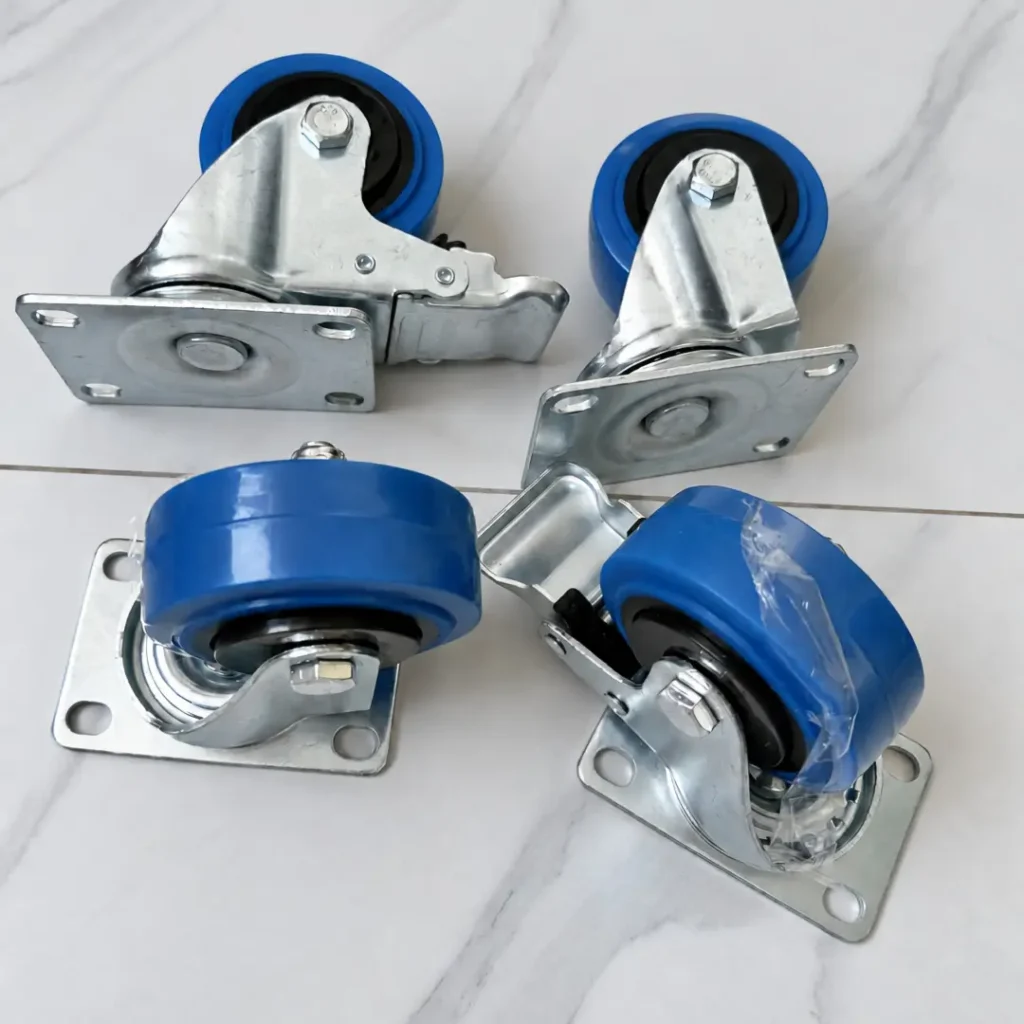
Two blue 4 inch casters can have the same tread and still be wrong replacements for each other. On a flight case, the mounting geometry, installed height and access to the brake are often the deciding details. This guide helps case builders and repair buyers specify the rolling base before ordering individual casters or a complete set.
Flight case castor, road case caster and flight box wheel are overlapping buying terms. They describe the case application, not a standard hole pattern. Start with the case drawing and the route through venues, workshops and loading areas. For a coordinated purchase, use the blue TPR flight-case caster set specification.
1. Identify the Mount before Measuring the Wheel
| Mount description | How to recognise it | What the supplier needs |
|---|---|---|
| Top plate / flat plate | An external plate is bolted to the case base. | Plate length and width, hole centres, slots, fixings and base reinforcement |
| Corner caster | A purpose-made bracket fits a case edge or corner. | Bracket profile, case wall thickness, offsets and fixing locations |
| Recessed or luggage-style wheel | Part of the wheel assembly sits inside the case structure. | Recess shape, protrusion, mounting depth and side clearance |
| Stem or socket mount | A stem, screw or socket connects the caster to the frame. | Full interface drawing, retention and mounting support |
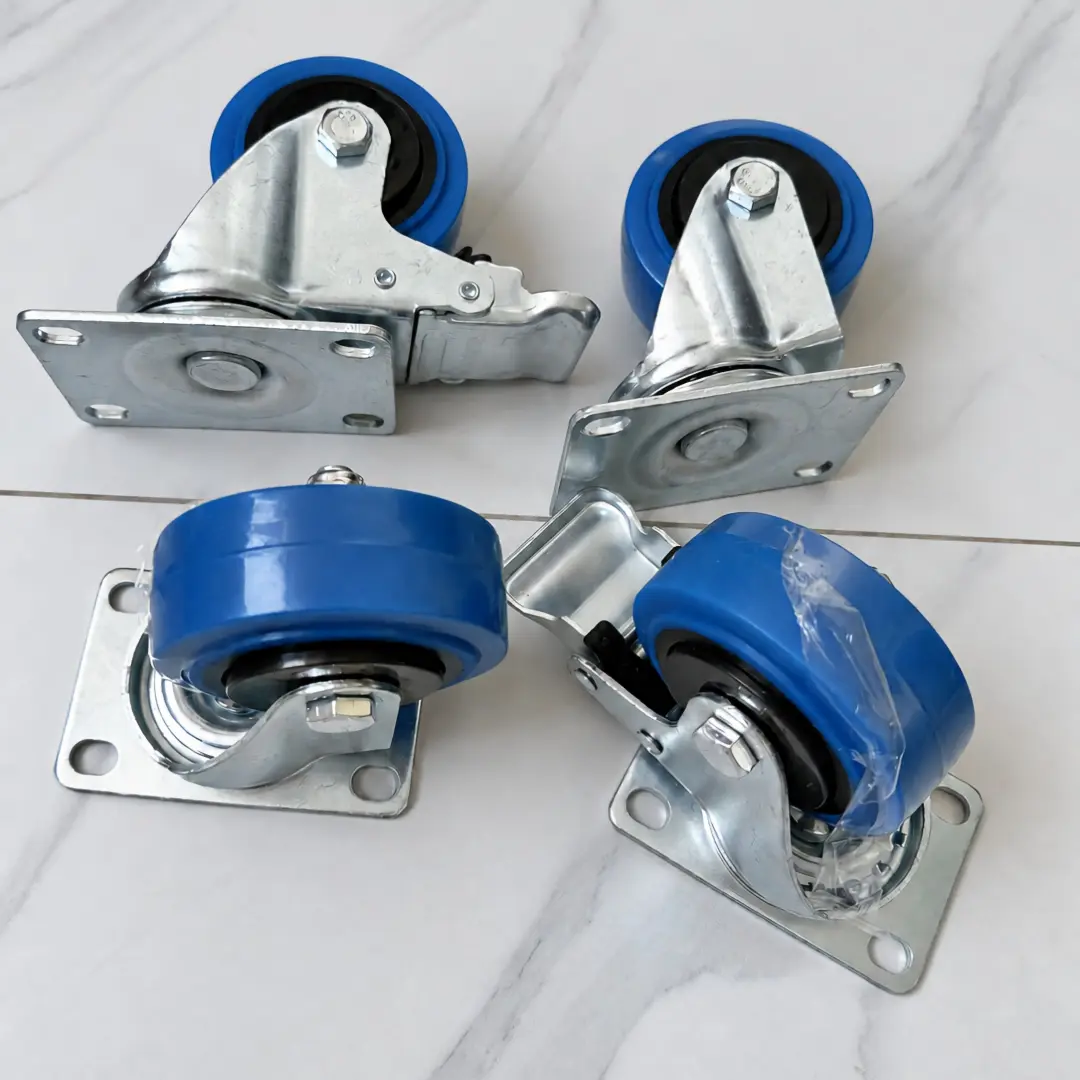
The TPR photographs supplied for this series show top-plate assemblies. They do not show a recessed corner bracket or a square-cup fitting. If the parts list says “blue corner caster,” “square edge brake caster” or “square cup accessories,” identify the intended part in a marked drawing before choosing a replacement.
2. Measure a Plate Pattern from the Correct Points
- Measure the outside length and width of the plate.
- Measure fixing-hole centres, rather than only the distance between hole edges.
- Record slot length, slot width and the intended fixing position.
- Measure installed height from the plate seating face to the floor.
- Record the maximum swivel radius and the pedal sweep.
- Show nearby edge extrusions, corner hardware, lids, skids and handles that could obstruct movement.
A “European mounting dimension” is not a complete universal specification. Commercial plates can use different external sizes, hole centres and slotted arrangements. Do not assume a new plate fits because the wheel is described as 100 mm, 4 inch or 100 × 32 mm. Ask for the actual assembly drawing.
3. Plan Steering and Brakes as a Layout
| Layout | Practical behaviour to assess | Design question |
|---|---|---|
| Four swivel casters | Allows changes of direction and lateral positioning. | Can the loaded case be controlled through the planned route? |
| Two fixed and two swivel casters | Provides a more defined travel direction. | Is the steering end aligned with the handle and turning space? |
| Braked swivel positions | Adds a specified parking function. | Can the operator reach the pedals without moving or lifting the case? |
| Custom position arrangement | Fits an existing case base or handling system. | Are support, clearance and retention defined at every position? |
A wheel brake restrains wheel rotation. A dual brake or total-lock request normally requires both wheel and swivel restraint, while a directional lock may allow the wheel to keep rolling. State the function on the position list. “With brake” by itself is not enough to ensure two quotes describe the same mechanism.
For component selection, link the position list to the braked TPR caster, the unbraked swivel caster and, where needed, the rigid caster. The case-set page remains the purchasing entry point for the complete coordinated arrangement.
4. Fit the Wheel to the Case and the Route
Three common starting requests are 75 × 32 mm, 100 × 32 mm and 125 × 32 mm. A larger wheel changes installed height and can alter how the case rolls over floor joints, but it also needs space. Confirm wheel diameter in millimetres, overall height, ground clearance and how cases stack or locate on each other.
TPR can be a useful choice for quiet indoor handling and higher-specification instrument or event cases. Outdoor transfers, ramps, wet floors and thresholds should be described in the RFQ. The route and loading conditions determine whether the proposed assembly is appropriate; the flight-case label does not create an all-terrain rating.
5. Separate Parking from Transport Restraint
A caster brake is not a tie-down for a case carried in a vehicle. Define the parking requirement for loading or use, then separately define how the equipment is restrained during transport. Brake access and holding behaviour should be checked with the loaded case, not only with a loose caster on a workbench.
Use the TPR load-capacity guide to prepare the loaded case weight, support layout and required assembly rating. Do not multiply a headline wheel capacity by four without considering actual support and load distribution. The case base and its reinforcement must also suit the duty.
6. Make the RFQ Repeatable for Production and Repair Stock
| RFQ field | Example of useful detail |
|---|---|
| Case base | Drawing revision, material, reinforcement and thickness |
| Position list | Number of fixed, swivel and braked casters per case |
| Wheel specification | Actual diameter, tread width, colour reference and bearing arrangement |
| Mounting | Plate or bracket drawing, hole pattern and installed height |
| Operating conditions | Loaded weight, route, frequency, ramps or thresholds |
| Commercial scope | Number of cases, individual spares, fasteners, kit labels and packing |
Codes such as W18 or SSR may be useful within a supplier’s catalogue, but they do not replace the drawing. A “double bearing” description must identify the hub or swivel raceways. Likewise, a flat blue tread, square edge, steel plate and corner bracket are different characteristics that should be recorded separately.
Common Replacement Questions
Can a normal plate caster replace a recessed luggage wheel?
Only after the case structure and installation have been redesigned or confirmed suitable. Similar wheel diameter does not make those mounts interchangeable.
Can the same TPR wheel be used for a flight case and a handcart?
Possibly. The useful comparison is the entire mounting, load and route specification. The final assembly and layout may differ even when the wheel component is shared.
Does a dual-locking caster eliminate all case movement?
It provides the specified restraint at the caster. Floor condition, frame flex, clearance and the complete case layout still affect movement; confirm the required behaviour on the assembled case.
Technical Reference
For general mounting terminology and the dimensions associated with plates, bolt holes and stems, see Blickle’s fitting-type guide. Use the approved Gleam assembly drawing for your order.
View the TPR caster configuration range
Request a Configuration-Matched Quotation
Send a bottom view of the case, a marked mounting drawing, loaded weight, wheel-size request, position list and brake function. Include any corner or recessed bracket requirements before selecting the caster set.