
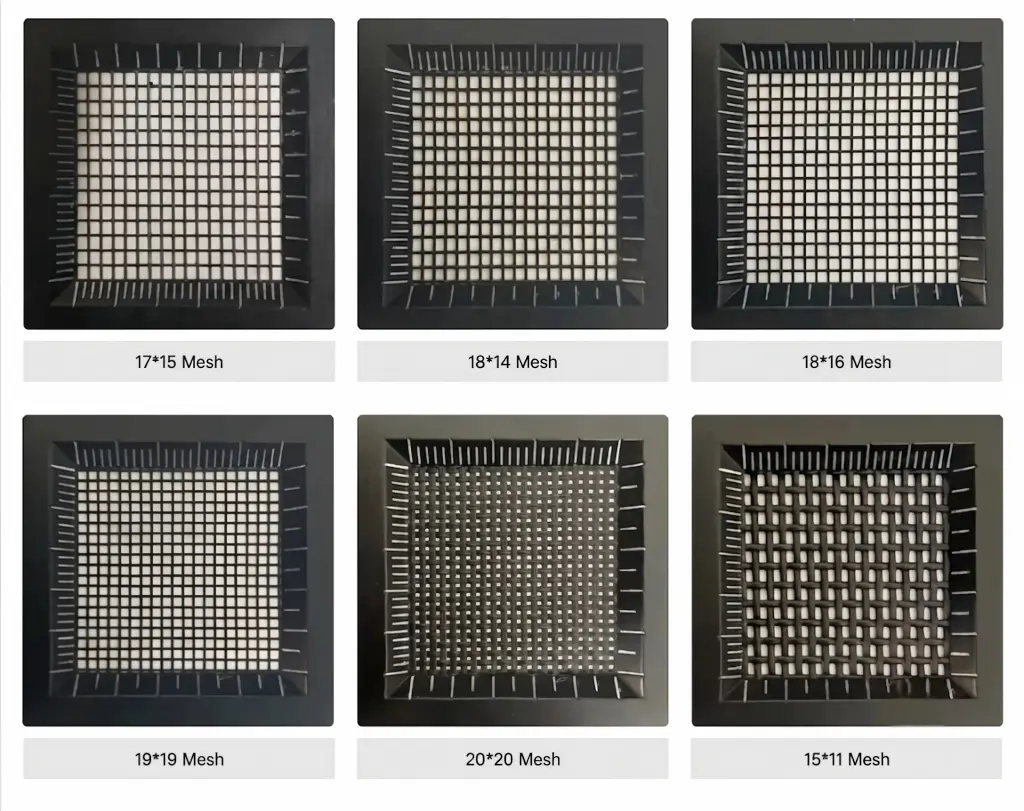
Two window screen mesh quotations can both say “18×16” and still describe different products. The yarn may be thicker, the coating heavier, or the roll shorter. For an importer or window fabricator, those differences affect material cost, visibility, installation and the number of screens produced from each roll.
A useful specification brings five measurements together: mesh count, finished yarn diameter, opening size, weight per square metre and roll dimensions. This guide explains how to compare them before approving a sample or placing a bulk order.
What does 18×16 window mesh mean?
Mesh count is specified per linear inch in both weave directions. A nominal 18×16 screen has a count of 18 in one direction and 16 in the perpendicular direction. The two numbers are not the roll dimensions or the weight of the fabric.
Keep both directions in the purchase specification. A description such as “18 mesh” leaves part of the construction unclear. Also distinguish insect screening from construction reinforcement mesh: a square opening stated in millimetres belongs to a different measurement system and may describe an entirely different product.
For ordinary window production, 14×12, 16×14, 16×16 and 18×16 can be options within a standard PVC-coated fiberglass insect screen range. Choose between them using a physical sample, the intended insects and the finished frame.
Yarn diameter explains why equal mesh counts differ
“Wire diameter” is common in purchasing enquiries. For fiberglass screen, the more precise term is finished yarn diameter; for stainless steel screen, wire diameter is appropriate. Ask whether a stated diameter includes the coating. Overall fabric thickness, measured across crossing yarns, is a separate dimension.
For an ideal plain weave, approximate clear opening can be calculated as 25.4 ÷ mesh count − finished yarn diameter, with dimensions in millimetres. Apply the calculation separately in each direction. This is an illustration of the geometry, not a substitute for measuring the supplied mesh.
For example, a 20×20 construction with 0.20 mm yarn has an approximate 1.07 mm opening. With 0.33 mm yarn, the opening is about 0.94 mm. Both are called 20×20, but their balance of open space and material is different.
Common reference constructions for insect screening
The examples below are published market specifications for quotation comparison. Final supply dimensions, weight tolerance and construction should be recorded against the approved sample.
| Screen construction | Mesh count | Finished yarn diameter | Reference weight | Buying consideration |
|---|---|---|---|---|
| PVC-coated fiberglass option | 14×12 | Specify in quotation | Specify in g/m² | Compare the opening and target insect requirement. |
| PVC-coated fiberglass options | 14×14; 16×16 | Specify in quotation | Specify in g/m² | Count is available in the market; select the complete construction. |
| Standard fiberglass option | 16×14 | 0.28 mm | Confirm in g/m² | Specify the weight separately; mesh count alone is insufficient. |
| Standard PVC-coated fiberglass | 18×14 | 0.28 mm | 103 g/m² | Compare with 18×16 at the same yarn diameter. |
| Standard PVC-coated fiberglass | 18×16 | 0.28 mm | 110±5 g/m² | A common starting point for window and door screen production. |
| Fine-yarn, high-visibility fiberglass | 20×20 | 0.203 mm | 81 g/m² | Fine yarn supports a less prominent screen appearance. |
| Fine-aperture fiberglass | 20×20 | 0.33 mm | 200 g/m² | Smaller openings suit enquiries focused on small insects. |
Sources: HikingScreen lists 14×12; HB Yinuoqianjin lists 14×14 and 16×16 fiberglass options. JWFG publishes the 16×14 diameter example and a complete 18×16 weight specification. The 18×14 and two 20×20 constructions appear separately in bash-tec’s technical catalogue, pages 9, 10 and 13. Other published fiberglass options include 17×15 and 19×19. These counts do not imply one fixed yarn diameter or GSM.
For a small-insect requirement, compare the 20×20 fine-mesh fiberglass screen options using opening size and sample performance. A finer count does not, by itself, establish protection against every insect species.
GSM measures fabric weight, not overall quality
GSM means grams per square metre. It includes the material present in the finished mesh, including its coating. A higher number can reflect heavier yarn or more coating, but it does not automatically mean better visibility, easier installation or longer service.
For an incoming check, weigh a measured piece without its wrapping. Divide its mass in grams by its area in square metres. A 0.5 × 0.5 m sample covers 0.25 m², so a 27.5 g result corresponds to 110 g/m². Record the sampling method and agreed tolerance rather than comparing a bare sample with a packed roll.
Roll width and length change the usable cost
Common metric formats include widths such as 0.6, 0.8, 1.0, 1.2, 1.5 and 1.8 m, with 30, 50 or 100 m lengths in standard fiberglass ranges. Availability depends on the construction. ADFORS also lists imperial fiberglass roll formats, including 100 ft lengths.
A 100 ft roll is 30.48 m, not exactly 30 m. Compare prices per usable square metre, then allow for trimming, defects and the cutting pattern. A wider roll is economical only when your frame sizes use that width efficiently.
Put the agreed specification on the order
Include material and coating, both mesh counts, finished yarn diameter, GSM tolerance, colour, usable width, minimum roll length and packing. Attach the approved sample reference and identify any required inspection report.
Where distributors need visible roll identification, custom printing and coloured selvedge options can help distinguish agreed product lines. Confirm the artwork, edge treatment and batch label separately from the base mesh specification.
Explore the window mesh product overview, or compare the material choices in our fiberglass versus stainless steel screen guide. For a quotation, send your target specification, roll quantity and destination market; a sample is useful when the existing mesh is difficult to identify.