
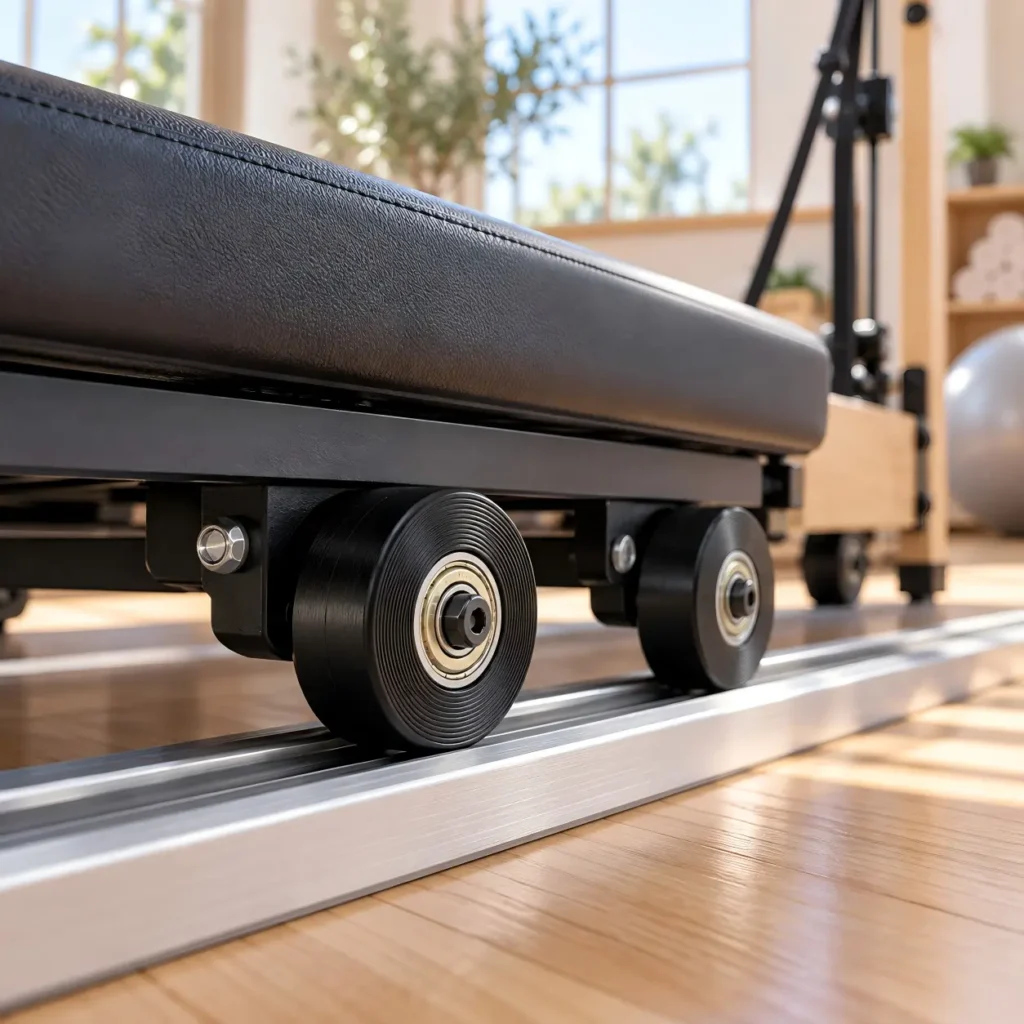
How to choose Pilates reformer replacement wheels begins with identifying the job of each wheel and measuring the complete installation—not choosing from outside diameter alone. This guide is written for reformer manufacturers, parts importers, distributors, studio service teams and private-label buyers preparing an OEM enquiry.
A clear specification protects margin at both ends of the supply chain. The importer avoids stocking incompatible parts, the distributor can label models accurately, and the studio receives a kit that technicians can install with less guesswork.
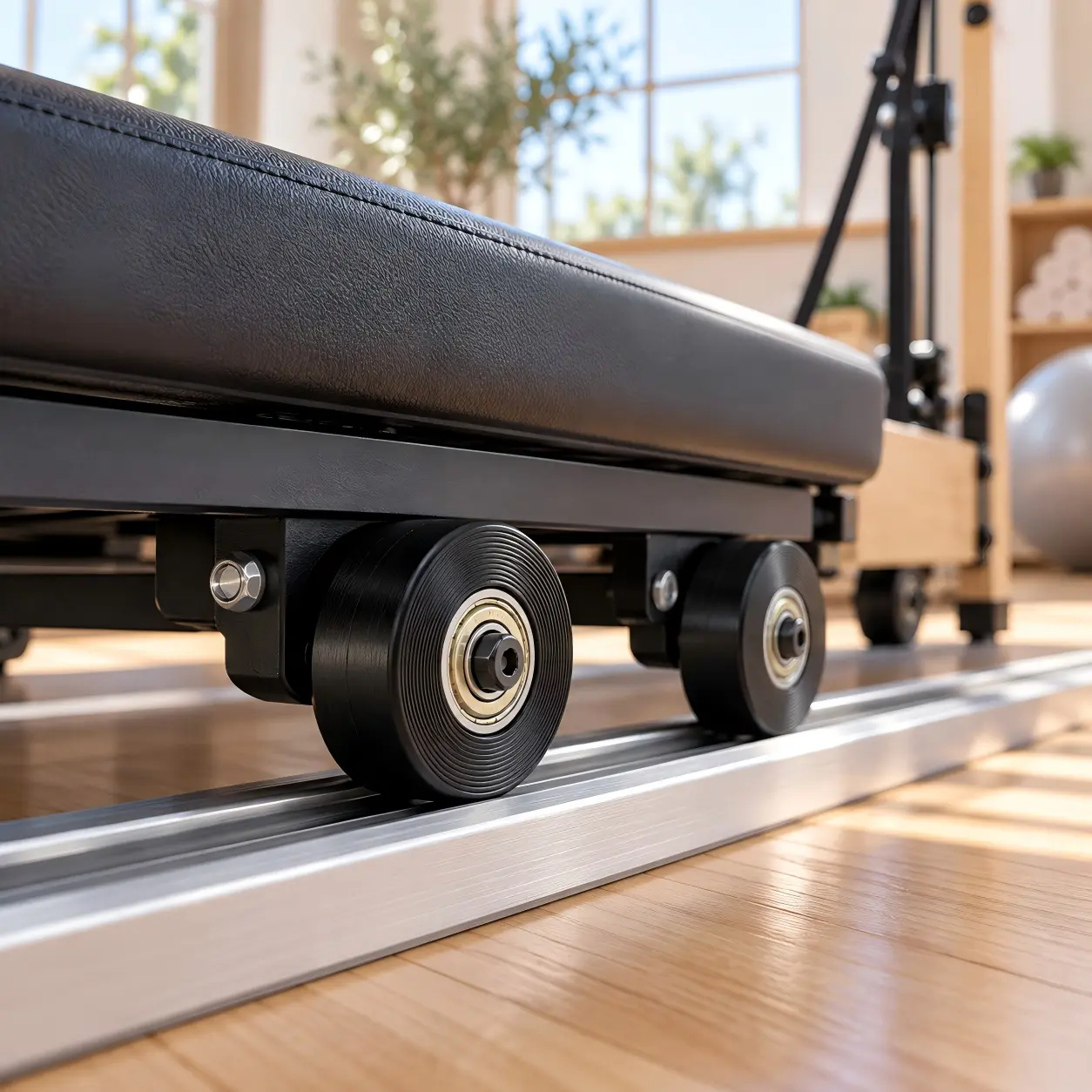
1. Identify What the Wheel Actually Does
| Wheel or pulley position | Primary job | Common purchasing terms |
|---|---|---|
| Carriage rolling wheel | Supports and moves the carriage along the rail | Pilates reformer wheels, carriage wheels, replacement rollers |
| Side or lateral guide wheel | Controls side play and carriage tracking | Side wheels, lateral guide wheels, guide rollers |
| Fixed or floating roller | Position-specific support or alignment function | Fixed rollers, floating rollers |
| Rope pulley | Guides cord through a defined groove and angle | Pilates reformer rope pulley, grooved pulley wheel |
| Transport wheel | Moves or stores the equipment | Reformer transport wheels, additional wheels |
These parts may look similar in a small catalog image but are not interchangeable. Mark each wheel location on a side photo of the reformer before measuring it.
2. Record Seven Fit Dimensions
- Outside diameter: measure across several points, avoiding a worn flat spot.
- Running width: measure the section that contacts the rail.
- Total hub or stack width: include protruding bosses where relevant.
- Bore or bearing: record bore, bearing code, outside diameter and width.
- Axle and spacer: measure the axle diameter, shoulder and spacer length.
- Profile or groove: identify flat, crowned, V-shaped or rope-groove geometry.
- Installed clearance: measure nearby frame, rail and fastener space.
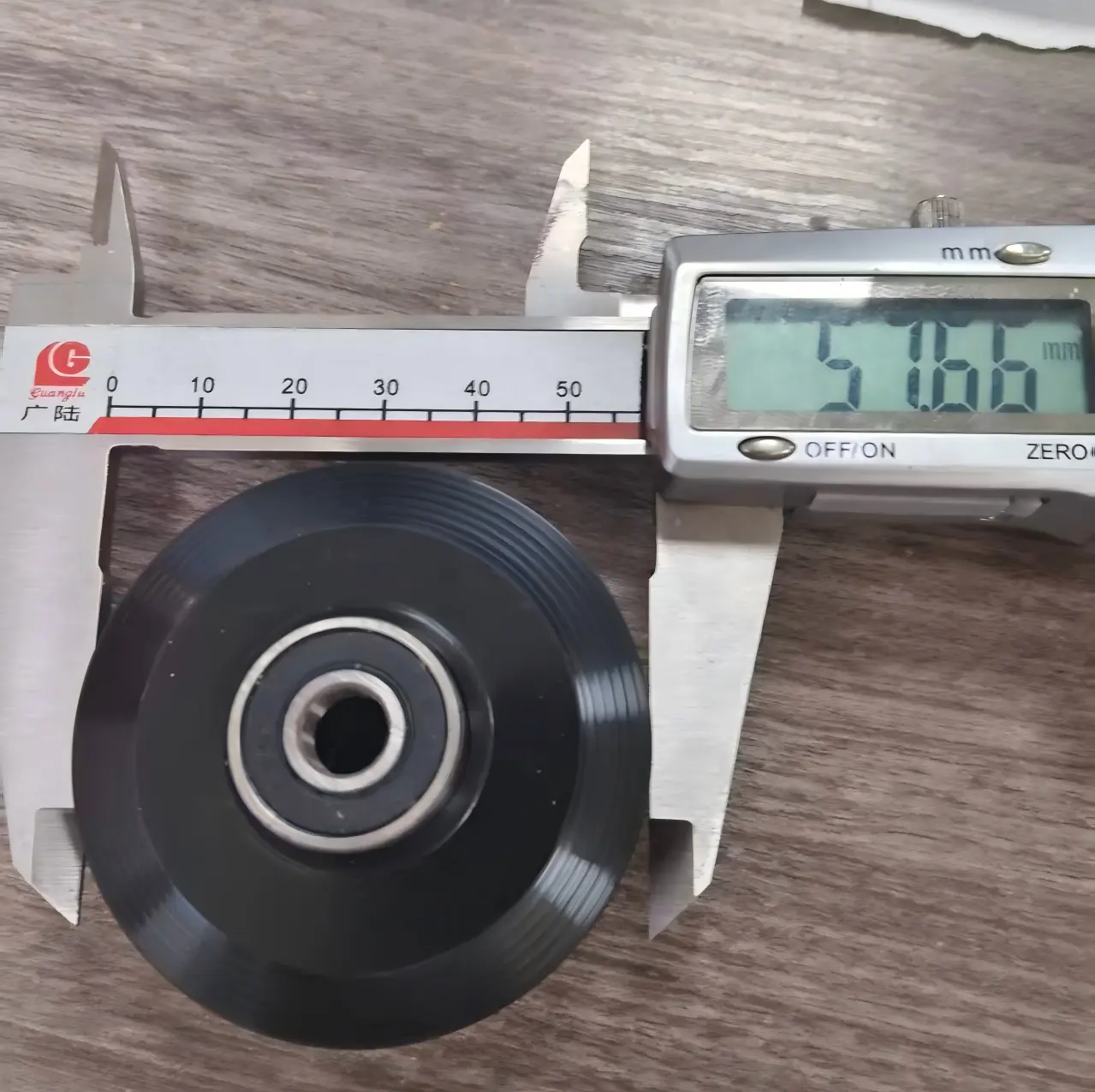
Common search sizes such as 52 mm, 57 mm, 58 mm, 59 mm and 72 mm are useful for discovery, but there is no single universal commercial-reformer wheel standard. A measured 57.66 mm sample may be treated as nominal 58 mm only when the approved tolerance supports that definition.
3. Match Material and Core to the Duty
Cast polyurethane is frequently selected for carriage wheels because it can balance wear, rolling comfort and dimensional control. Engineering plastics may suit compact guide wheels and pulleys where rigidity is important. Rubber can be considered for selected low-speed duties, although its deformation and wear behaviour must be evaluated.
A metal core can support the bearing seat and help control compression in higher-static-load designs. A reinforced polymer core may provide an economical, lighter construction where the load permits. Neither option is automatically superior; compare the complete sample under the intended conditions.
4. Understand 85A, 90A and 92A Hardness
Shore A hardness is one selection property. 85A may provide more compliance, while 90A and 92A are firmer references that buyers often consider where support and lower deformation are priorities. The actual ride also depends on PU chemistry, tread thickness, core, bearing and rail.
ASTM D2240 is a recognized hardness test reference. Rebound, abrasion and compression set require separate tests. If wear is important, ISO 4649:2024 describes rotating-drum abrasion methods, but it does not give one universal pass value for every Pilates wheel.
5. Specify Bearing, Spacer and Axle as One System
A 608 bearing commonly measures 8 × 22 × 7 mm, yet the suffix, shield/seal, grease, clearance and supplier can differ. Confirm whether the wheel is supplied bare, with bearings installed, or as a kit containing spacers and fasteners. A correct bearing installed in the wrong hub stack can still create drag or lateral movement.
For quiet operation, prioritize accurate bearing seating, concentricity, clean rails and correct alignment. Do not accept a high ABEC label unless the bearing specification and source support it.
6. Calculate Load as a Carriage System
For an early quotation, 50–100 kg per wheel can be used as a common preliminary carriage-wheel reference, with 80–120 kg considered for selected metal-core designs. These are not final ratings. The user, carriage, springs and dynamic movement create a system load that is not always shared equally by every wheel.
State the total expected load, number and position of wheels, rail support, static dwell time and duty cycle. The supplier can then propose a wheel construction and sample test. For long static storage, evaluate residual deformation after a defined recovery period.
7. Diagnose Noise Before Replacing Everything
| Symptom | Possible cause | Check first |
|---|---|---|
| Squeak | Contaminated rail, bearing seal, dry contact or alignment | Clean rail; rotate each bearing by hand; inspect mounting |
| Rhythmic bump | Flat spot, wheel damage or debris | Mark wheel position; inspect the full circumference |
| Knock or side movement | Loose fastener, spacer error or guide-wheel clearance | Check axle stack and lateral guide adjustment |
| Heavy carriage | Bearing drag, overtight guide, rail damage or misalignment | Lift and test each wheel position separately |
A universal “below 30 dB” promise is not meaningful without speed, load, measuring distance, rail and background conditions. Agree a repeatable installed test if noise is a purchase requirement.
8. Build an OEM RFQ That Can Be Quoted Correctly
- Equipment brand/model and production revision, where available.
- Photo showing every carriage, side, pulley and transport-wheel position.
- Original sample or dimensioned drawing.
- Diameter, width, hub/stack, bearing, axle, spacer and groove measurements.
- Material/core and 85A, 90A or 92A hardness preference.
- Total load, wheel count, static dwell and operating frequency.
- Annual quantity by SKU and target sample quantity.
- Logo, model label, barcode, kit components and export packing.
A Better Replacement Range Is Easier to Sell
- Group parts by verified machine fit, not only by a rounded diameter.
- Use a dimension diagram and installation photo on every distributor SKU.
- Offer bearing-installed kits where that reduces technician errors.
- Retain the drawing, golden sample and inspection results for repeat orders.
Recommended Product Routes
Start with the OEM Pilates reformer wheel programme. Review 52mm replacement wheels, 58mm metal-core wheels, 90A/92A PU carriage wheels, silent bearing wheels and custom rope pulleys. The Pilates reformer wheel supplier hub brings the complete range together.
Frequently Asked Questions
Can I select a replacement wheel only by machine brand?
No. The same brand can use different wheels across models or production revisions. Verify the installed part and dimensions.
Which hardness is best?
There is no universal answer. Compare ride, rail, load, noise and static deformation on the actual machine.
Should all wheels be replaced together?
Replacing a matched set can improve consistency when wheels have similar wear, but inspect side guides, bearings and rails before deciding.
Prepare a Complete Reformer Wheel RFQ
Send your machine photo, wheel-position map, sample or drawing, measurements, load, quantity and kit requirements. We will review the correct product route.