
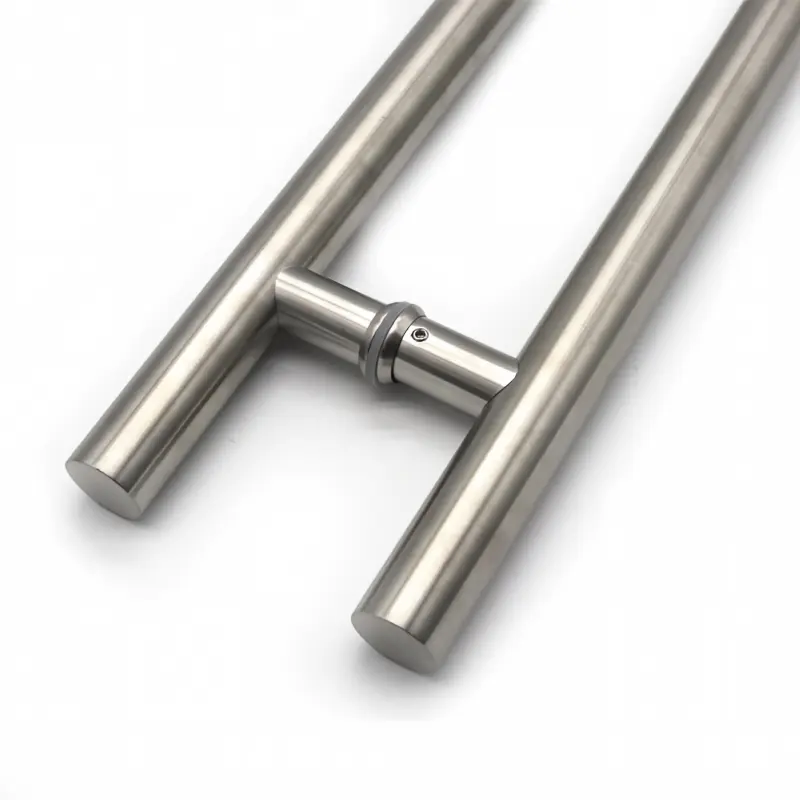
Learning how to measure glass door handle hole spacing starts with identifying the centers of the mounting holes. The end-to-end length of the grip is a separate dimension. Before an importer orders replacement handles or a contractor releases a hotel door schedule, both values need to appear clearly on the drawing.
Ready to choose a model? Use the glass door handle selection table to compare styles, then review the common production sizes and custom options alongside your measurements.
This guide explains the measurements to collect, a practical way to cross-check center-to-center distance, and the information needed to review a complete handle set. Qingdao Gleam Hardwares uses drawing and sample review for Manufacturer/OEM enquiries. The worked dimensions below explain a method; they are not dimensions or tolerances for an advertised product.
What does center-to-center hole spacing mean?
Center-to-center distance, often written C-to-C, C-C or hole pitch, is the distance between the axes of two mounting holes. Overall length is the distance between the outer ends of the handle. Two handles can have the same overall length and different mounting centers, or the same mounting centers and different overall lengths.
| Dimension | Record it as | Why it matters |
|---|---|---|
| Mounting centers | C-to-C, with units and the drawing revision | Locates the fixing points on the glass. |
| Overall handle length | End-to-end grip length | Controls the visible size; does not establish hole pitch. |
| Prepared glass holes | Diameter of each hole and its position from the glass edges | Must suit the approved fixing and isolation components. |
| Glass thickness | Actual panel thickness and glass specification | Affects the compatible mounting assembly. |
| Projection and clear grip space | Outermost projection and usable gap behind the grip | Helps check hand clearance and collisions. |
| Tube profile | Round diameter or square section; wall thickness if specified | Describes the handle construction, not the glass hole diameter. |
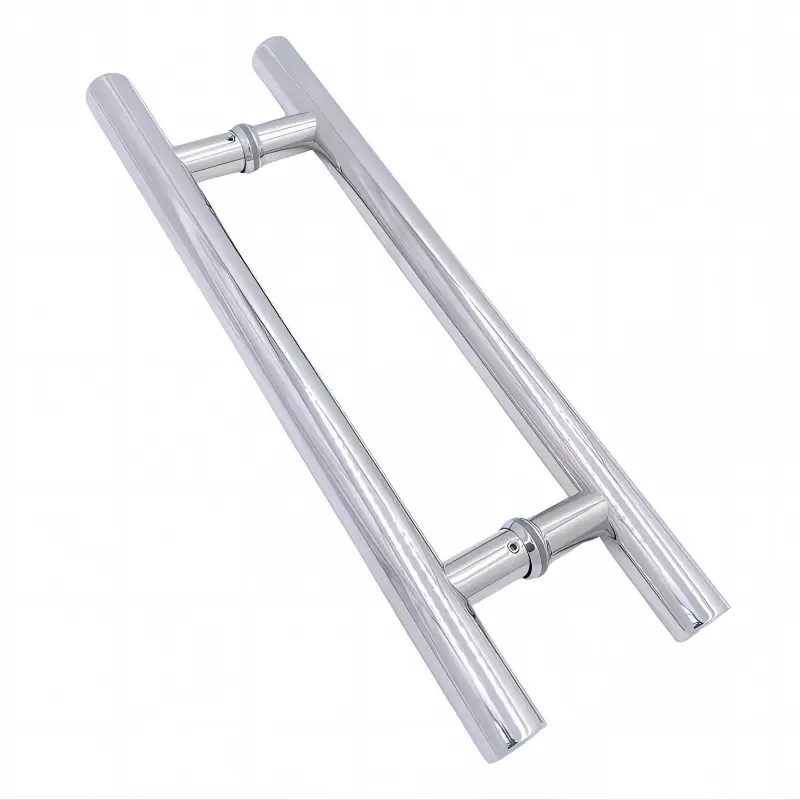
How to measure glass door handle hole spacing
- Start with the approved glass drawing. Identify the opening, orientation, drawing number and revision. For a replacement, compare the drawing with the actual installation before relying on the old part description.
- Identify the mounting axes. Decorative collars can hide the prepared holes. If access requires removing hardware, ask a qualified installer to inspect it safely; do not loosen door-support components to obtain a measurement.
- Measure directly between centers where accessible. Keep the measuring tool aligned with the line joining the holes, and record the units. Repeat the reading to identify a measurement or transcription mistake.
- Cross-check using hole edges. For two equal circular holes, measure the outside-to-outside distance along their centerline and subtract one hole diameter. Alternatively, measure the inside gap and add one hole diameter.
- Record the remaining interface dimensions. Include each hole diameter, glass thickness, edge offsets and projection. A correct C-to-C measurement alone does not confirm fit.
| Measurement | Example reading | Calculated C-to-C |
|---|---|---|
| Outside-to-outside distance O, hole diameter d | O = 312 mm; d = 12 mm | O − d = 300 mm |
| Inside edge gap I, same hole diameter d | I = 288 mm; d = 12 mm | I + d = 300 mm |
These example readings describe an imagined measurement, not a standard hole size. The edge methods assume equal circular holes and measurements taken on the line through both centers. If holes differ in size, are slotted, are damaged or cannot be accessed clearly, record the geometry for technical review instead of applying this shortcut.
24 inches, 600mm and 1200mm: avoid a unit mismatch
24 inches equals 609.6mm exactly. It is not the same as 600mm. A request for a “24-inch handle” must also say whether that dimension is the overall length or the mounting centers. Preserve the original specified value and confirm any proposed metric substitution before ordering.
Likewise, a 1200mm stainless steel glass door pull handle enquiry describes a requested long format, not an automatic 1200mm hole pitch. State the required overall length and C-to-C separately. If a project requests 32mm round tube, do not copy 32mm into the glass-hole field; tube diameter and fixing-hole diameter serve different purposes.
Check clearance before approving the replacement
For frameless shower glass door pull handles, review the fully open and fully closed positions. A sliding panel may move past another glass panel, while a hinged door needs clearance through its swing. Record the available space near seals, walls and adjacent fittings, including the usable grip gap.
If appearance is being changed to a square tube glass door handle, compare projection and collar footprint as well as mounting centers. For curved glass door pull handles, the bow or wave shape also changes the grip envelope. Matching the holes does not guarantee that the new shape clears surrounding surfaces.
Match the fixing kit to the glass drawing
Confirm the through-bolts, thread specification, fixing engagement, collars, isolation sleeves and washers as a coordinated assembly. Do not substitute a bolt solely because it fits through the glass hole. The hole, sleeve and fastener each have a separate dimension, and the installer needs the approved assembly details and tightening instructions.
Do not drill, enlarge, notch or cut an already tempered glass panel to make a different handle fit. Vitro Architectural Glass explains the restriction on further fabrication after heat treatment in Technical Document TD-124. Refer an incompatible existing panel to the glass professional for an appropriate replacement or compatible hardware solution.
If your glass door has non-standard mounting centers, use our custom hole pitch glass door pull handle for a drawing review. Send the actual C-to-C, hole diameters and glass thickness so the grip and fixing kit can be specified together.
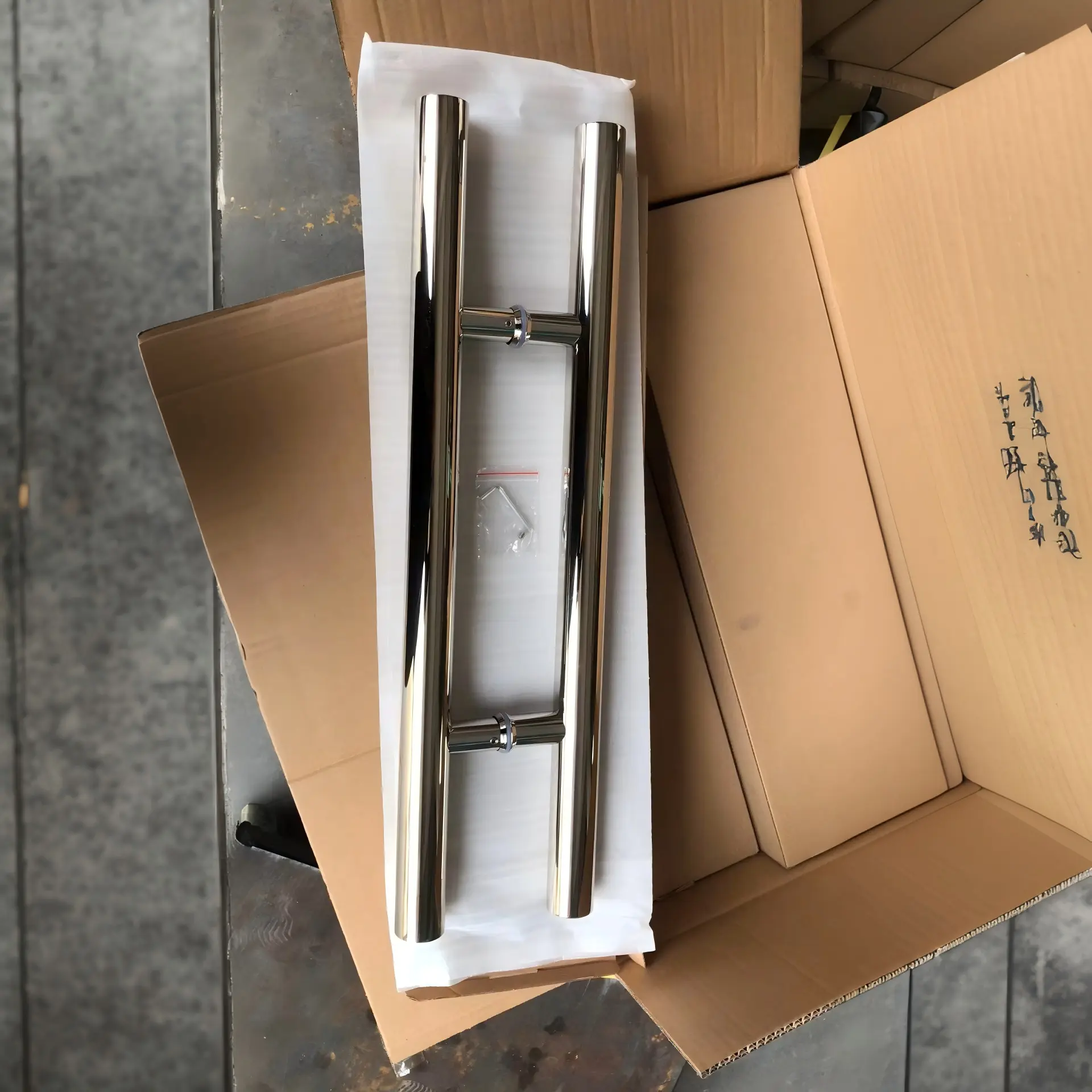
A measurement sheet that is ready for quotation
Label each opening or handle variant separately. Include the quantity of complete paired sets, finish reference, requested grade, packing labels and spare-kit requirement alongside the dimensions. Attach an overview photo, close views of the fixing arrangement and the latest drawing. Keep uncertain measurements marked “to confirm” rather than allowing assumptions to become an order specification.
For mixed projects, record which rows share a fixing kit and which need a different one. Agree a sample-fit review on representative glass and retain the approved revision for repeat orders. Material selection is a separate decision: use the SS304 vs SS316 glass door handle guide to prepare the exposure and finish information.
Select a Handle from Your Measurements
- Existing holes that must be retained: send the measured C-to-C and glass preparation for custom hole-pitch handles.
- Short mounting centers in a shower enclosure: compare frameless shower handles and check the opening clearance.
- A long grip on the door schedule: use the 1200 mm entrance pull and record its mounting centers separately.
Frequently asked questions
Can I order from the overall handle length alone?
No. Provide mounting centers, prepared hole sizes, glass thickness and clearance information as well. Overall length identifies the visible format but does not establish mounting compatibility.
Can a handle with slightly different centers be forced into place?
Do not force the assembly or alter heat-treated glass. Confirm the actual measurements and have the hardware and glass professional review a compatible solution. Tolerances belong on the approved drawing.
Can the old handle be sent as a sample?
A sample can help review shape and mounting details, but also send the glass drawing or measured hole positions. Identify damaged or missing components so their condition is not mistaken for the intended specification.
Send your drawing for a handle fit review
Working on an office entrance, hotel bathroom or replacement program? Send your glass drawing, C-to-C dimensions and project quantities for OEM fit review. Include the required material, finish and complete fixing kit. Availability and production timing are confirmed with the quotation. You can also compare the glass door pull handle families before preparing the enquiry.